Dovetail vs Beavertail: The Real Difference Explained
If you have been shopping for an equipment trailer, you have probably run into the terms “dovetail” and “beavertail” and wondered what exactly they mean. Both describe the rear section of an equipment trailer that helps you load heavy machinery, but they work in very different ways. Choosing the wrong one can mean fighting every time you try to load your skid steer, excavator, or Bobcat. Choosing the right one makes the whole job effortless.
At Trailer Place in Wharton, TX, we stock a wide selection of equipment trailers from brands like Diamond C and Iron Bull. Our team helps buyers across Texas and Louisiana pick the right rear-end style for their specific machines every day. Here is what you need to know.
What Is a Dovetail?
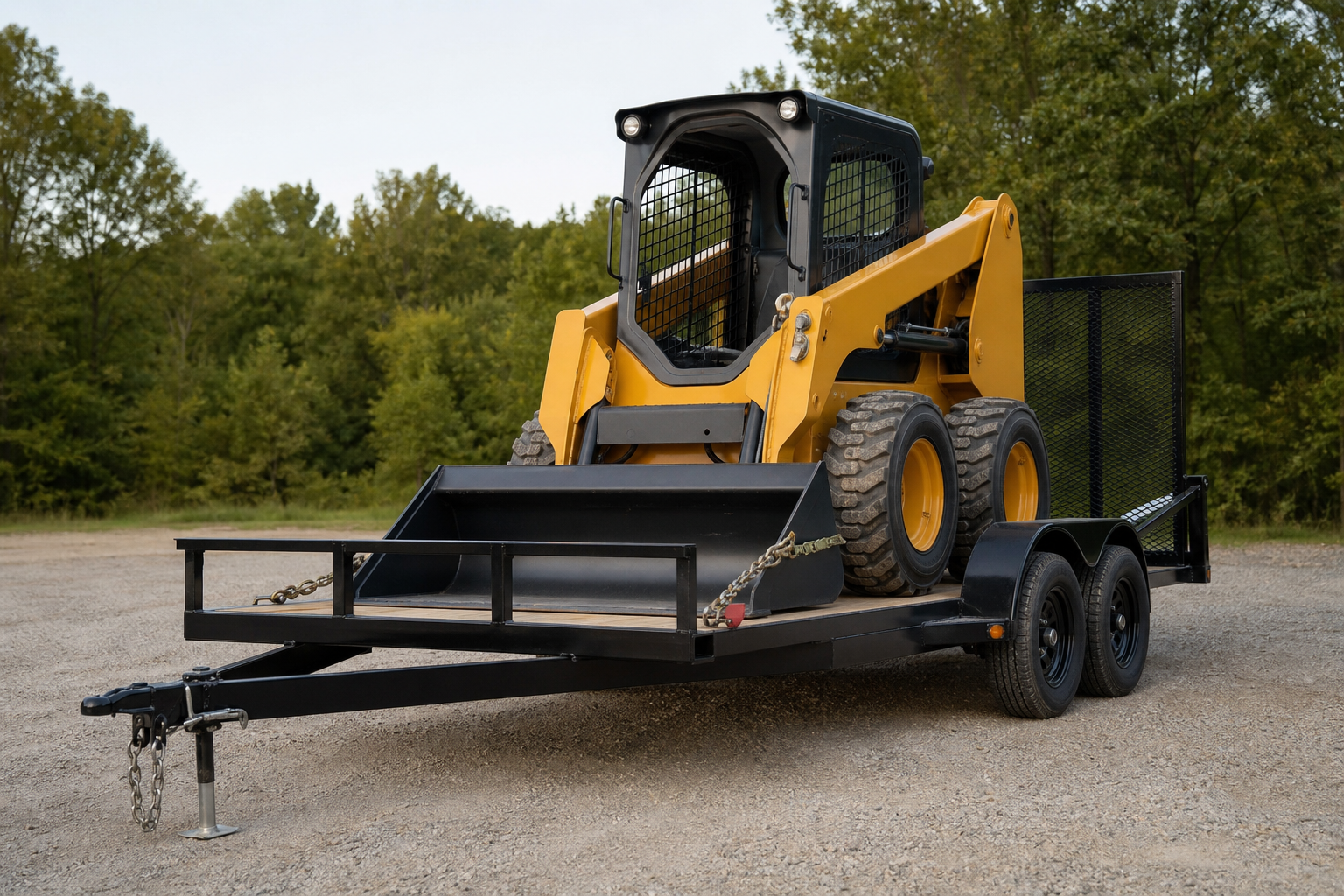
A dovetail is a section at the rear of the trailer deck that angles downward toward the ground. The slope is built directly into the steel structure of the trailer frame. When you back your equipment toward the trailer, you drive down the angled ramp naturally.
Dovetails come in two main configurations:
- Fixed dovetail: The angle is permanently built in. There are no moving parts. You simply drive on and the low angle eases the transition from the ground onto the deck. Best for machines with decent ground clearance.
- Dove with flip-over ramps: A fixed dovetail with fold-out ramps attached at the end. The ramps flip down to bridge the gap from the ground to the dovetail. Common on Diamond C equipment trailers and gives you extra loading flexibility.
A standard dovetail drops between 18 and 28 inches over a length of 4 to 8 feet depending on the trailer model. The longer and more gradual the taper, the better it handles low-clearance machines.
What Is a Beavertail?
A beavertail is a very slight upward curve or taper at the very end of the trailer deck — just enough to ease the transition from the ground without creating a sharp break-over angle. Think of it as the trailer deck ending with a gentle lip instead of a blunt edge.
Beavertails are much shallower than dovetails. The deck stays mostly flat, and the beavertail just blends the rear edge smoothly so equipment does not high-center or bang against the corner when loading.
Some trailers pair a beavertail with fold-down ramps. The ramps hinge at the rear, fold flat for transport, and drop down to create a loading angle. This is sometimes called a beavertail with ramps or a channel ramp setup.
Dovetail vs Beavertail: Side-by-Side Comparison
| Feature | Dovetail | Beavertail with Ramps |
|---|---|---|
| Loading angle | Built-in gradual ramp, no separate ramps needed | Fold-down ramps provide loading angle |
| Deck length | Shorter flat deck (dovetail takes up 4-8 ft) | More flat deck space |
| Best for | Tracked equipment, low-clearance loaders | Wheeled equipment with decent clearance |
| Loading effort | Drive straight on, very easy | Ramps must be deployed and stowed |
| Ground clearance needed | Less — low machines load easily | More — machine must clear the ramp-to-deck transition |
| Flat deck usability | Cannot stand/strap on the dovetail section | Full flat deck from front to back when ramps are up |
| Weight savings | Lighter (no ramp hardware) | Slightly heavier (ramp hinges, pins) |
Which Should You Choose?
Choose a Dovetail If:
- You haul tracked equipment like mini excavators, track skid steers, or rubber track loaders. The low angle protects both the tracks and the trailer deck.
- You load and unload solo and want the fastest process — no ramps to deploy or store.
- Your machine has low ground clearance and would hang up on a sharp ramp-to-deck transition.
- You want a simpler trailer with fewer moving parts to maintain or break.
Choose a Beavertail with Ramps If:
- You haul wheeled equipment like forklifts, telehandlers, tractors, or skid steers on tires.
- You need the maximum flat deck space for tying down large footprint machines or hauling multiple pieces at once.
- You want to stand on the full deck when strapping down loads.
- The machines you load have decent ground clearance and won’t hang up on the ramp angle.
Equipment Trailers We Carry
Trailer Place carries a strong inventory of equipment trailers with both dovetail and beavertail configurations. A few standouts:
- Diamond C FMAX Equipment Trailer: Available in 20-ft to 30-ft lengths, GVWRs from 14,000 to 25,900 lbs, with optional mega ramps or dovetail configurations. One of the most popular heavy-duty options we stock. Priced from around $8,500 to $20,000+.
- Iron Bull ETB/ETE Equipment Trailers: 14,000 to 20,000 lb GVWR with dovetail and ramp options. Heavy-duty I-beam construction, suitable for excavators and heavy loaders. Priced from $7,000 to $16,000.
- Diamond C EH Equipment Hauler: A 20,000 lb GVWR beast built for construction sites, with 8-inch I-beam main frame and heavy-duty mega ramps. Great for rental company fleets and serious contractors.
Not sure which configuration is right for your specific machine? Our team can help. Tell us what you’re hauling — the brand, model, and approximate weight — and we’ll point you to the right trailer for the job.
A Quick Note on GVWR
Whatever rear-end style you choose, make sure your equipment trailer’s GVWR covers your machine’s operating weight with a comfortable margin. A 5,000-lb mini excavator needs at minimum a 10,000-lb GVWR trailer, but a 14,000-lb GVWR gives you room to grow. For detailed guidance, see our GVWR and payload weight explainer and our towing guide to match your truck to your trailer.
Also make sure your truck can handle it. Equipment trailers in the 14,000-20,000 lb GVWR range typically require at minimum a three-quarter-ton truck, and a one-ton with a gooseneck ball is ideal for the heavier units.
Shop Equipment Trailers at Trailer Place
Trailer Place is a family-owned dealership serving Wharton, Houston, and the greater Texas Gulf Coast, with customers coming from as far as Louisiana. We carry Diamond C, Iron Bull, and a full lineup of equipment trailers in various lengths, GVWRs, and rear-end configurations. Our in-house STAR brand also offers specialty trailers built right here in Texas.
Ready to find the right equipment trailer? Call us at (979) 532-1486 or browse our equipment trailer inventory online. We offer financing, and we ship nationwide.