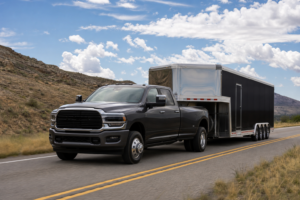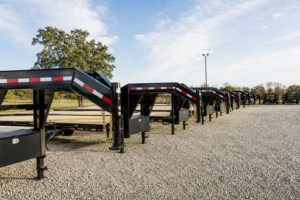

If you’re shopping for a heavy-duty truck to pull a trailer in Texas, the Ram 2500 and Ram 3500 are two of the most capable options on the market. Both are serious work trucks built for towing — but they serve different buyers. This guide breaks down the key differences so you can pick the right truck for your trailer and your wallet.
Ram 2500 vs Ram 3500: The Core Difference
The Ram 2500 is a 3/4-ton heavy-duty truck. The Ram 3500 is a one-ton heavy-duty truck. Both are built on the same HD platform, share most of the same powertrain options, and look nearly identical from the outside. The difference is in payload capacity, towing capacity, and rear axle configuration — and those differences matter a lot when you’re pulling a heavy trailer.
Towing Capacity Comparison (2026)
Here’s a quick side-by-side for the 2025-2026 model years:
| Spec | Ram 2500 | Ram 3500 SRW | Ram 3500 DRW |
|---|---|---|---|
| Max Towing (5th wheel/GN) | Up to 20,000 lb | Up to 26,000 lb | Up to 37,090 lb |
| Max Conventional Towing | Up to 19,680 lb | Up to 21,340 lb | Up to 23,000 lb |
| Max Payload | Up to 3,160 lb | Up to 4,050 lb | Up to 7,680 lb |
| Rear Axle Options | SRW only | SRW only | DRW (dually) |
| GVWR | ~10,000 lb | ~11,500 lb | ~14,000 lb |
Note: Actual ratings vary by cab configuration, powertrain, and options. Always check the door-jamb sticker on the specific truck you’re buying.
Powertrain Options
Both trucks offer the same two engine choices:
- 6.7L Cummins Turbo Diesel — The preferred choice for serious towing. Produces up to 420 hp and 1,075 lb-ft of torque (High Output version). This is what most Texas trailer buyers spec.
- 6.4L HEMI V8 Gas — More affordable, better for lighter-duty use. Fine for pulling lighter trailers but not ideal for regular heavy hauling.
The diesel Ram 2500 and 3500 are among the most capable tow vehicles ever built. If you’re pulling a gooseneck trailer loaded with equipment, cattle, or heavy machinery, the Cummins diesel is the engine to have.
What Trailers Can Each Truck Pull?
Ram 2500 Is Best For:
- Dump trailers up to 14,000 lb GVWR (14k equipment or 12k dump trailers)
- Equipment trailers in the 10,000-16,000 lb GVWR range
- Livestock trailers — 16-20 ft bumper pull or smaller gooseneck stock trailers
- Flatbed trailers up to 20 ft gooseneck at light-to-mid loads
- Car hauler trailers for 1-2 vehicles
The Ram 2500 handles the majority of trailer purchases at Trailer Place without any issue. Most utility trailers, enclosed trailers, and medium-duty dump trailers fall well within its capability window.
Ram 3500 Is Best For:
- Heavy gooseneck trailers — 20,000 lb+ GVWR loads
- Large equipment trailers in the 16,000-22,000 lb GVWR range
- Full livestock gooseneck trailers — 24 ft cattle trailers loaded with cattle or horses
- Hotshot trucking — 40 ft RGN or gooseneck trailers running highway miles
- Oversized dump trailers — 16k-20k GVWR commercial models
- Heavy equipment hauling — excavators, skid steers, large tractors
If you’re a rancher hauling 20+ head of cattle, a hotshot operator running commercial goosenecks, or a contractor moving excavators regularly — the Ram 3500 is the truck you need. The DRW (dually) version adds stability, higher payload, and dramatically higher gooseneck tow ratings.
Payload: The Number Most Buyers Ignore
Towing capacity gets all the attention, but payload capacity is equally important. Payload determines how much weight can be placed on your truck — including the tongue weight of your trailer.
For a bumper pull trailer, tongue weight is typically 10-15% of the trailer’s loaded GVWR. For a gooseneck, the kingpin weight riding in the bed can be 25-30% of trailer GVWR. That means a 20,000 lb loaded gooseneck puts 5,000-6,000 lb on your truck bed alone. A Ram 2500 with 3,100 lb payload would be overloaded in that scenario — the Ram 3500 DRW with 7,680 lb payload is the right fit.
When shopping, always check the yellow Tire and Loading Information sticker in the driver’s door jamb — not just the marketed max payload. Cab, bed length, and trim level all affect real-world payload numbers.
Price Difference
The Ram 3500 typically costs $3,000-$7,000 more than a comparably equipped Ram 2500. The diesel option adds another $10,000-$11,000 over the gas engine. For most trailer buyers in Texas, the diesel Ram 2500 hits the sweet spot of capability and cost — unless you genuinely need the extra capacity of the 3500.
Which Truck Should You Buy?
Buy the Ram 2500 if:
- Your trailers stay under 16,000-18,000 lb loaded GVWR
- You’re not running full gooseneck cattle loads or heavy excavators
- Budget matters and you don’t need max-rated capability every day
- You want a capable daily driver that also handles trailer duty
Buy the Ram 3500 if:
- You regularly haul heavy gooseneck or fifth-wheel loads over 18,000 lb
- You’re doing hotshot trucking commercially
- You need maximum payload for a gooseneck cattle or horse trailer
- You move heavy equipment (excavators, large skid steers, tractors) regularly
- You want the dually (DRW) configuration for stability and max-rated numbers
Ready to Match Your Truck to the Right Trailer?
At Trailer Place in Wharton, TX, our team helps buyers match their tow vehicle to the right trailer every day. Whether you’re pulling with a Ram 2500, Ram 3500, or any other truck — we’ll make sure you leave with a trailer that fits your truck and your job. We carry Diamond C, Iron Bull, Kaufman, Calico, and many more top brands — with financing available for all credit situations.
Call us at (979) 532-1486 or stop by our dealership in Wharton to browse current inventory. We ship trailers nationwide and serve customers across Texas and Louisiana.
Also check out our guides on the Ram 2500 towing guide, what GCWR means for towing, and whether you need a weight distribution hitch.