
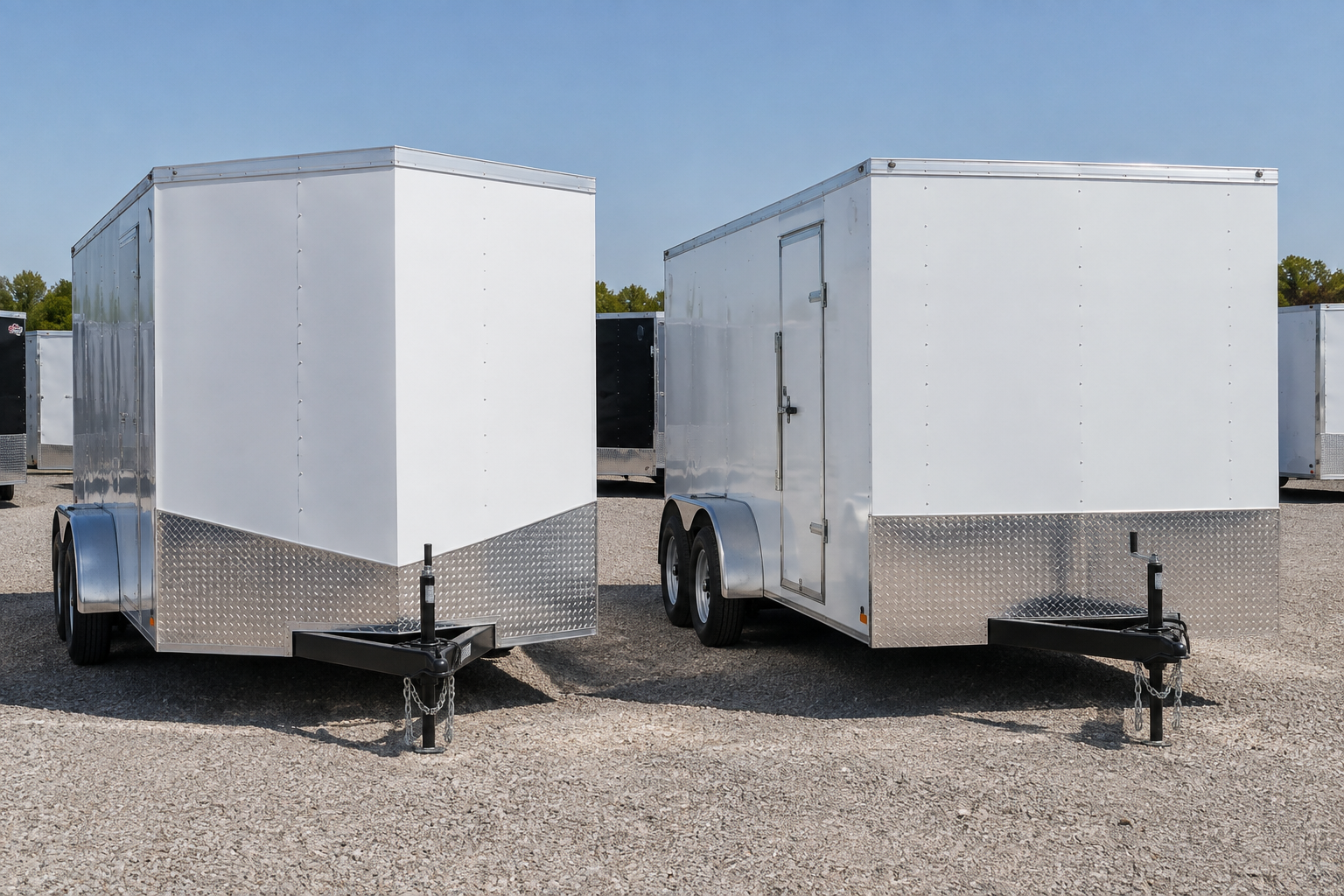
Walk any enclosed cargo trailer lot and you’ll notice two distinct front-end shapes: the pointed “V-nose” and the squared-off flat front. Both designs show up across nearly every brand we carry, and buyers often assume the V-nose is simply the “upgrade” option. The truth is more nuanced — each shape has real advantages depending on what you haul, how you tow, and what you’re willing to spend. Here’s how they actually compare.
What’s the Difference?
A V-nose enclosed trailer has a front wall that comes to a point, similar to the bow of a boat, usually with a couple extra feet of “wedge” space added ahead of the main box. A flat-front enclosed trailer has a simple squared-off front wall, giving you a rectangular box from front to back with no wedge area.
Aerodynamics and Fuel Economy
This is the V-nose’s strongest selling point. The pointed front cuts through highway wind resistance more efficiently than a flat wall, which matters most if you’re towing long distances at highway speed on a regular basis — think hotshot haulers, traveling vendors, or anyone racking up serious miles. Owners towing flat-front trailers at 70+ mph on the interstate typically notice more wind buffeting and a small fuel economy hit compared to an equivalent V-nose model. If your trailer mostly makes short local trips, this difference is much less noticeable.
Interior Space and Usable Storage
Here’s where flat-front trailers pull ahead. That V-nose wedge looks like bonus space on paper, but the sloped walls make the front few feet hard to use for anything except small, light items — coolers, tie-down straps, spare parts. A flat-front trailer keeps every square foot of the box fully rectangular and usable all the way to the front wall, which matters a lot if you’re hauling pallets, cabinetry, ATVs, or anything with square corners. Contractors and movers loading a 6×12 or 7×14 enclosed cargo trailer to the walls often prefer the flat front simply because nothing gets wasted to an unusable wedge.
Price Difference
V-nose construction requires more framing and panel work at the front, so V-nose models typically run $300-$900 more than an equivalent flat-front trailer in the same length and axle configuration. On a 6×12 single-axle enclosed trailer that might mean the difference between roughly $5,200 and $5,800; on a 7×14 tandem-axle model it can be a $500-$900 gap. If budget is the deciding factor and you’re not towing long highway miles regularly, a flat-front model gets you the same cargo protection for less money.
Best Use Cases for Each
- Choose V-nose if: you tow long highway distances regularly (hotshot trucking, traveling vendors, frequent out-of-state hauls), you want the added front wedge for lightweight loose-item storage, or you’re chasing every mile-per-gallon you can get
- Choose flat-front if: you need every inch of usable rectangular space for pallets, tools, or square cargo, your trips are mostly local or regional, or you want to save a few hundred dollars without giving up cargo protection
Both styles are available across the brands we stock, including Diamond C and our in-house STAR line, in single-axle and tandem-axle configurations. For help deciding between axle counts once you’ve picked a nose style, see our single axle vs tandem axle trailer guide.
Financing and Availability in Texas
We keep both V-nose and flat-front enclosed cargo trailers in stock at our Wharton, TX lot (moving to Rosenberg mid-2026), and we ship nationwide if your exact configuration isn’t sitting on our gravel right now. Financing is available on approved credit — see our trailer financing guide for details, including options for buyers rebuilding credit.
Not sure which nose style fits your hauling needs? Call Trailer Place today at (979) 532-1486 and we’ll walk you through both options in stock, with financing available on approved credit.