If you run a hay and feed business in Texas, your trailer is just as important as your truck. Whether you are delivering round bales to ranchers across three counties, hauling 50-pound sacks of sweet feed, or picking up bulk commodity loads from a co-op, the right trailer saves time, protects your product, and keeps your operation running smoothly. At Trailer Place in Wharton, TX, we work with hay dealers, feed store owners, and farm supply operators every week. Here is what we recommend.
What Hay and Feed Operators Actually Haul
Before picking a trailer, think about your load mix. Most hay and feed operators deal with some combination of:
- Round bales (800 to 1,800 lbs each) stacked 2 to 3 high
- Square bales (40 to 130 lbs each) stacked in rows
- Bulk bagged feed, mineral blocks, and tubs
- Palletized product picked up with a pallet jack or forklift
- Fencing supplies, pipe, and steel posts for farm customers
- Seasonal loads like fertilizer, seed, and lime
Each load type has different requirements for deck length, weight rating, stake pockets, and loading method. The good news is that a single well-chosen trailer can handle most of this work.
Best Trailer Types for Hay and Feed Operations
1. Gooseneck Flatbed Trailers (Top Pick for Large Hay Loads)
For operators moving 10 to 20-plus round bales per trip, a gooseneck flatbed is the workhorse of choice. The fifth-wheel connection keeps the load weight centered over the rear axle of your truck rather than hanging off the ball hitch, which dramatically improves stability and tow vehicle longevity when you are hauling at or near capacity every day.
Look for decks in the 24- to 40-foot range with 3-inch structural channel crossmembers spaced 12 inches on center. Heavy hay loads are hard on trailer floors, so thicker steel matters. A GN with 25,900 lb GVWR gives you serious payload room once you subtract the trailer’s own weight (typically 6,000 to 8,000 lbs).
We carry Diamond C and Iron Bull gooseneck flatbeds in various configurations. The Diamond C GN flatbed is popular for its I-beam main frame and adjustable coupler, while the Iron Bull GN line is priced competitively for operators needing multiple trailers in their fleet. Browse our gooseneck trailer inventory.
2. Bumper Pull Flatbed Trailers (Versatile for Smaller Loads)
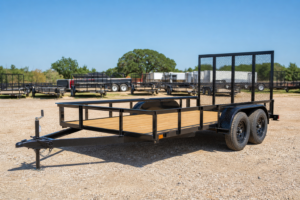
Not every delivery needs a gooseneck rig. If you are running a feed store with a pickup truck making daily deliveries of bagged product, palletized feed, and the occasional square bale order, a bumper pull flatbed trailer in the 16- to 22-foot range is often the right call.
A tandem-axle bumper pull flatbed with 14,000 lb GVWR handles most retail delivery work without requiring a commercial driver’s license in Texas (loads under 26,001 lb GVWR combined do not trigger CDL requirements for most operators). Stake pockets along the sides let you run pipe or lumber stanchions to keep round bales from rolling on shorter hauls.
The Iron Bull SBF (steel bumper pull flatbed) and Diamond C LPT (low-profile tilt) are both excellent choices for feed store delivery rigs. Check our flatbed trailer inventory for current availability.
3. Dump Trailers (Bulk Commodity and Cleanup)
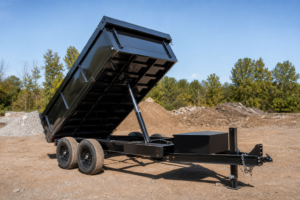
If your operation deals in bulk commodities — whole corn, cracked corn, cottonseed, wheat middlings, or similar loose products — a dump trailer can save your crew hours of shoveling time. A 14-foot to 16-foot dump trailer with 14,000 lb GVWR and a hydraulic scissor lift will handle bulk grain deliveries or cleanup at the store yard.
Dump trailers also work well for hauling broken-down hay that cannot be sold retail, manure, dirt, and general farm cleanup. We stock Diamond C and Iron Bull dump trailers in 10,000 to 21,000 lb GVWR ratings.
4. Utility Trailers (Light Delivery and Farm Errands)
Smaller feed stores and farm supply shops often need a second trailer for quick delivery runs, trade shows, or picking up small orders at the co-op. A utility trailer in the 7,000 to 9,900 lb GVWR range is easy to pull with a half-ton truck, requires no CDL, and is simple to park at customer properties. These work great for bagged feed, mineral blocks, fencing staples, and hardware deliveries.
Key Features to Look for in a Hay and Feed Trailer
- Heavy-duty deck boards or steel floor: Hay bales and pallet jacks are rough on floors. Oak or treated pine 2×8 boards are standard; some operators prefer all-steel floors for longevity.
- Stake pockets every 24 inches: Lets you customize how you contain round or square bales with pipe stanchions or lumber sides.
- Adequate tongue weight capacity: A loaded hay trailer tongue puts heavy downforce on your hitch — make sure your truck’s hitch receiver and ball mount are rated for the load.
- Electric brakes on all axles: Mandatory for anything over 4,500 lb GVWR in Texas. Non-negotiable for safety when hauling multi-ton hay loads.
- LED lighting: Hay deliveries sometimes run early morning or late evening during harvest season. LED lights last longer and stay brighter than incandescent.
- Treated or galvanized frame: Texas humidity and standing hay moisture can rust out a trailer frame fast. Look for galvanized undercarriage components or regular maintenance with rust-inhibiting paint.
Tow Vehicle Considerations for Hay Loads
The weight of a full hay load can catch operators off guard. Ten 1,200-pound round bales weigh 12,000 lbs before you count the trailer. That puts you in one-ton truck territory at minimum. A Ford F-350, Ram 3500, or Chevy Silverado 3500HD with a gooseneck setup is the standard rig for serious hay haulers. For bagged-feed delivery work, a 3/4-ton truck pulling a bumper pull flatbed is usually sufficient.
Always check your truck’s actual payload rating (the sticker inside the driver’s door jamb) rather than the advertised towing capacity. Towing capacity and payload capacity are different numbers, and both matter when you are loading a flatbed with round bales.
Texas Regulations for Hay Haulers
Texas does not require a CDL for most farm and ranch operations below certain combined vehicle weights — but feed store operators making commercial deliveries can fall under different rules depending on whether they cross county lines, what they haul, and how their business is structured. The Texas Department of Motor Vehicles (TxDMV) and DPS have specific rules around commercial motor vehicle operations. If in doubt, consult a transportation attorney or contact TxDMV. Our Texas Trailer Registration and Title Guide covers the registration basics.
For loads wider than 8 feet or taller than 14 feet, you may need an oversize permit. Many hay trailers running with full loads of round bales stacked high fall into this category — plan accordingly.
Why Hay and Feed Operators Choose Trailer Place
We are a family-owned dealership in Wharton, TX — the heart of Gulf Coast ranching and farming country. We understand that this equipment is not a hobby purchase. It is a working tool, and downtime costs money. Our team helps you pick the right trailer for your actual load requirements, your tow vehicle’s ratings, and your budget.
We offer in-house financing for qualified buyers, nationwide shipping if you are not local, and we carry the full Diamond C, Iron Bull, and Kaufman gooseneck and flatbed lines in inventory. We also manufacture our own STAR brand galvanized cattle trailers for ranchers who need something built to last in Texas conditions.
Call us at (979) 532-1486 or stop by our lot in Wharton to talk through your trailer needs. We are open Monday through Saturday and happy to answer questions about load ratings, trailer configurations, and financing options. You can also browse our flatbed, gooseneck, dump trailer, and utility trailer inventory online any time.