Why Backing a Trailer Is a Skill Every Truck Owner Needs
You’ve bought the trailer. You’ve got the hitch. Now comes the part every new trailer owner dreads: backing up in tight spots. Whether you’re dropping a dump trailer at a job site, backing a horse trailer into a barn aisle, or parking a gooseneck at the fairgrounds, learning to reverse a trailer confidently is essential for any Texas truck owner.
The good news? It’s a learnable skill. With the right technique and a little practice, most drivers get the hang of basic trailer backing within an afternoon. This guide walks you through everything from understanding the physics to advanced maneuvers for tighter spots.
Understanding the Counter-Intuitive Physics
The first thing to know about backing a trailer: your instincts are wrong. When reversing, the trailer turns in the opposite direction of your steering wheel. Turn your wheel left and the trailer goes right. Turn right and the trailer swings left.
A simple mental trick that works for most beginners: place your hand at the bottom of the steering wheel. Move your hand left and the trailer goes left. Move your hand right and the trailer goes right. This “bottom of the wheel” method makes the motion feel natural and matches what you actually see in your mirrors.
Pre-Backing Setup: Set Yourself Up for Success
Before you put it in reverse:
- Adjust both side mirrors so you can see along both sides of the trailer. Towing mirrors (or clip-on mirror extenders) make a huge difference, especially with wide trailers like enclosed cargo trailers or equipment trailers.
- Walk the path before you back. Look for curbs, drop-offs, posts, low-hanging branches, or uneven ground you might miss in mirrors.
- Clear passengers or have a spotter stand outside at the rear corner of the trailer with line-of-sight to you.
- Start wide. Position your truck so you have as much room as possible to begin the maneuver. Starting position is 80% of success.
Step-by-Step: Straight-Line Backing
Straight-line backing is the foundation. Master this first:
- Align your truck and trailer in a straight line before you start reversing. Any pre-existing angle will amplify as you back up.
- Go slow. Idle speed in reverse is plenty. The faster you go, the less time you have to correct before the trailer drifts.
- Use micro-corrections. As soon as the trailer starts to drift even slightly from straight, apply a small correction. Don’t wait until it’s noticeably off.
- Look behind, not just in mirrors. Glance back through the rear window for a reference point down the center of the trailer.
- Pull forward to reset. If the trailer gets badly out of alignment, don’t fight it. Pull forward, re-straighten, and start again. Every experienced trailer driver has done this hundreds of times.
Step-by-Step: 90-Degree (Corner) Backing
Turning the trailer 90 degrees into a dock, gate, or parking space is the most common real-world maneuver:
- Position wide. Pull forward past your target turn, leaving yourself extra room on the opposite side.
- Begin reversing slowly and turn your wheel toward the side you want the trailer to go (remember: hand at the bottom of the wheel).
- Watch the trailer’s rear corner in your mirror. You want it to track toward the opening you’re aiming for.
- Straighten progressively. As the trailer lines up with the target space, begin straightening your wheel so the truck follows the trailer into alignment.
- Check both sides. Alternate between driver and passenger mirror constantly as you complete the turn.
With gooseneck trailers, the pivot point is in the bed of your truck rather than behind it, which gives you more control and a tighter turning radius. Goosenecks are generally easier to back than bumper-pull trailers once you learn the geometry.
Handling Jackknife: How to Prevent and Recover
Jackknifing happens when the trailer folds too sharply toward the truck. The best fix is prevention:
- Never let the trailer get past 90 degrees relative to the truck during backing.
- When you feel the trailer pulling sharply toward one side and correction isn’t working, pull forward immediately to reset.
- Short trailers jackknife more easily than long ones because the angle develops faster.
To recover from a mild jackknife: pull the truck forward while turning the wheel to re-straighten the trailer, then reposition and start the maneuver again from a better angle.
Backing Tips by Trailer Type
Dump Trailers
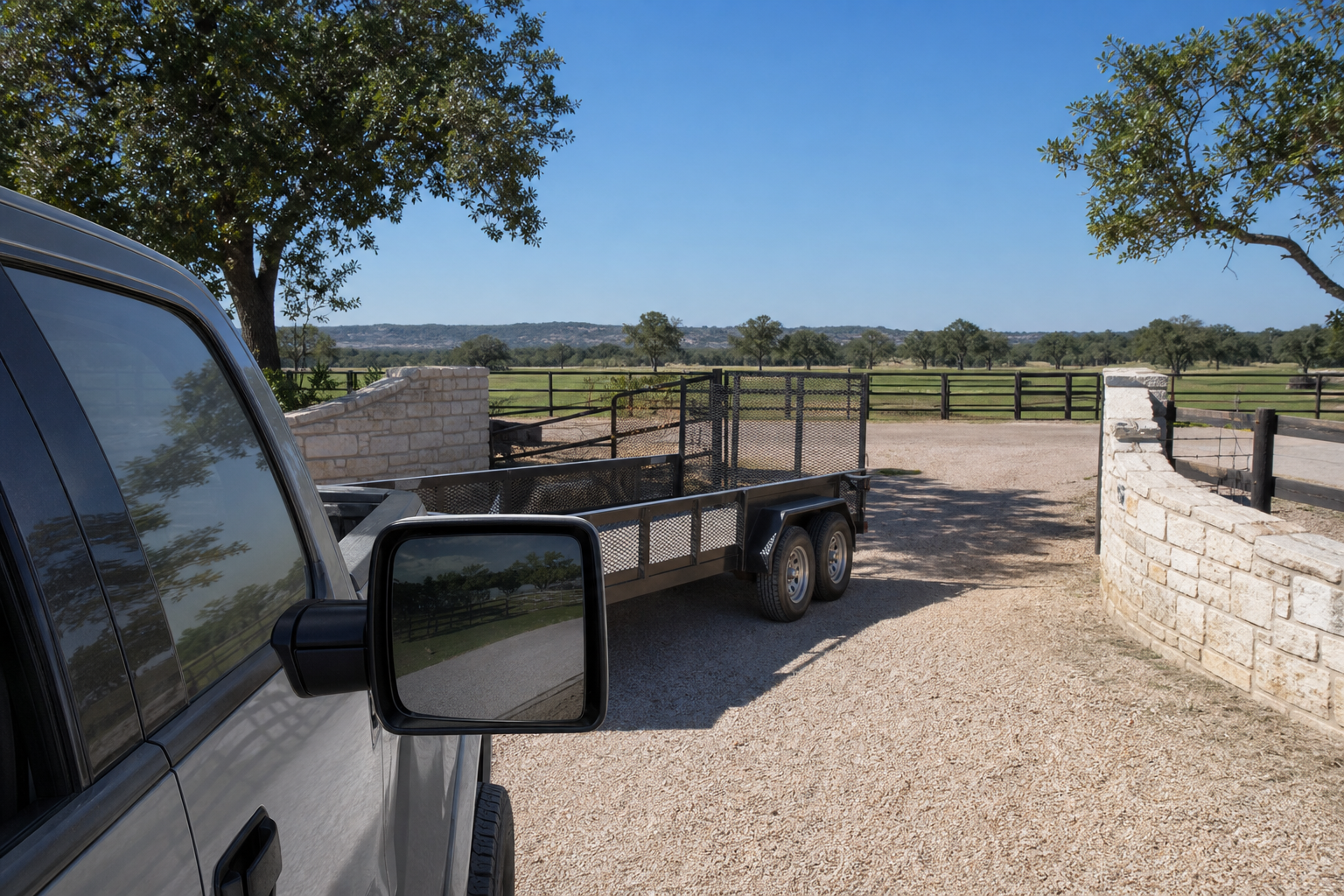
Dump trailers are usually 14 to 16 feet long on a bumper-pull. That’s a manageable length for backing, but be careful about ground clearance when backing into uneven ground at job sites. Always walk the area before reversing.
Enclosed Cargo Trailers
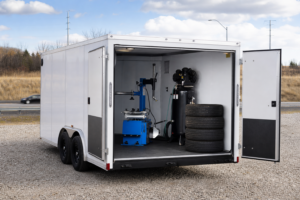
The tall walls of an enclosed trailer block your rear view entirely. You’re 100% on mirrors. This is where good towing mirrors earn their keep. Take it slow and use a spotter whenever possible.
Livestock and Horse Trailers
When animals are aboard, smooth and slow is the rule. Sudden movements spook livestock and can cause injuries. Livestock trailers are often heavier and longer, so give yourself extra room for corrections.
Car Hauler Trailers
Car hauler trailers extend well behind the rear axle of the loaded vehicle. Make sure the cars are secured and be mindful of the extra length when calculating your backing path.
Gooseneck Trailers
Because the hitch point is over the rear axle of your truck, gooseneck trailers respond more predictably to steering inputs. Many experienced haulers actually prefer backing goosenecks over bumper-pulls once they get used to the feel.
Practice Drills for New Trailer Owners
The fastest way to get confident is deliberate practice in a low-stakes environment:
- Empty parking lot drill: Set up two cones or water jugs about 10 feet apart as a “gate.” Practice backing through the gate straight, then at a 45-degree approach angle.
- Cone slalom: Place cones in an L-shape and practice 90-degree backing into the corner.
- One-hand method: Always keep one hand at the bottom of the wheel so the hand-direction corresponds to trailer direction.
- Time limit drills: Set a 5-minute timer. How many clean passes through the gate can you do? Improves focus and builds muscle memory faster than slow casual practice.
Gear That Makes Backing Easier
The right accessories reduce stress and prevent damage:
- Towing mirrors: Clip-on towing mirror extenders run $30-$80 and are one of the best investments for new trailer owners.
- Backup camera: Many modern trucks have a built-in trailer backup camera input. Aftermarket wireless units start around $100 and clip onto the trailer’s rear.
- Spotter radio or walkie-talkie: When a spotter is needed, hands-free communication eliminates shouting and miscommunication.
- Hitch alignment guides: Bright ball-and-socket alignment tools make hitching up easier after you’ve backed the truck to the trailer.
Common Beginner Mistakes to Avoid
- Going too fast: Speed amplifies errors. If you’re new, idle speed in reverse is fast enough.
- Overcorrecting: Small inputs, frequently applied. Big wheel movements create big oscillations that are hard to recover from.
- Not pulling forward to reset: Pride is the enemy here. Pull up and reset as many times as you need.
- Skipping the walk-around: Always walk the backing path before you reverse. One unnoticed stump or post can wreck a trailer or a tire.
- Wrong starting position: If you start badly positioned, the whole maneuver fights you. Reposition the truck first.
Find the Right Trailer at Trailer Place in Wharton, TX
Whether you’re buying your first trailer or upgrading to a bigger rig, Trailer Place carries a full lineup of dump trailers, gooseneck trailers, enclosed cargo trailers, livestock trailers, and more from trusted brands like Diamond C, Iron Bull, Kaufman, and Texas Pride.
We’re a family-owned dealership serving all of Texas and Louisiana, with financing available for all credit types and nationwide shipping. Call us at (979) 532-1486 or stop by our lot in Wharton, TX (moving to Rosenberg mid-2026) to talk trailers with someone who hauls them too.
Want more towing tips? Check out our guides on matching your truck to your trailer, understanding GCWR, trailer brake controller setup, and whether you need a weight distribution hitch.