If you plan to pull a heavy gooseneck trailer — a livestock trailer, flatbed, equipment hauler, or gooseneck dump — the first upgrade you need is a proper gooseneck hitch installed in your truck bed. Done right, a gooseneck setup gives you a rock-solid towing connection capable of handling 25,000 to 35,000 lbs GVWR or more. Done wrong, it is a safety hazard.
This guide walks you through everything you need to know: choosing the right hitch, tools required, installation steps, and how to stay legal in Texas. Whether you are upgrading a Ram 3500, Chevy Silverado 3500HD, or Ford F-350, the process is the same.
What Is a Gooseneck Hitch?
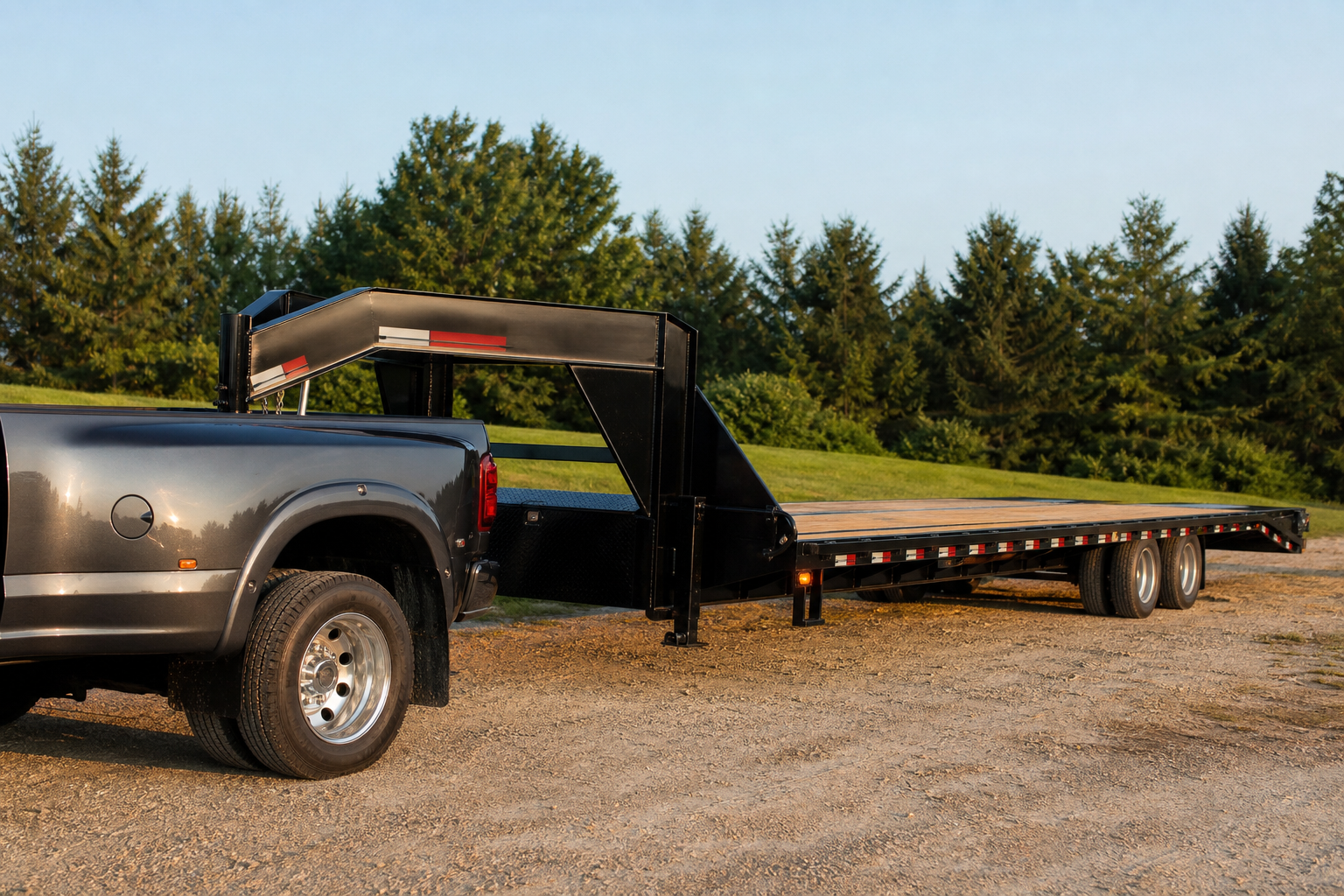
A gooseneck hitch mounts in the bed of your truck, centered over the rear axle. Unlike a conventional bumper-pull ball, the gooseneck ball sits inside the truck bed and the trailer’s gooseneck coupler hooks directly over it. This placement transfers tongue weight directly over the strongest part of the truck frame, making it far more stable than a bumper hitch for heavy loads.
Gooseneck hitches are rated by gross trailer weight (GTW) and tongue weight capacity. Most ball-over-gooseneck hitches are rated for 25,000 to 30,000 lbs GTW with 5,000 to 7,500 lbs tongue weight. Heavy-duty models (CURT, B&W, PullRite) go up to 35,000 lbs GTW for commercial haulers.
Step 1 – Choose the Right Gooseneck Hitch for Your Truck
Not all hitches fit all trucks. You need a hitch specifically designed for your truck’s year, make, and model. The most popular brands are:
- B&W Turnoverball – The gold standard for Texas ranchers and farmers. Recessed ball drops below bed level when not in use, so your truck bed stays fully flat. Works with B&W Companion 5th wheel adapter. Available for most 3/4-ton and 1-ton trucks.
- CURT Double-Lock EZr – Budget-friendly, under-bed installation, good for farm and light commercial use. Rated 25,000 lbs GTW.
- Reese Pro Series – Mid-range option, widely available at farm supply stores across Texas.
- PullRite SuperGlide – Premium option with a sliding rail system for tight turning radius in short-bed trucks.
If you are pulling a gooseneck trailer with a short-bed truck (less than 8 ft), you will need a sliding gooseneck or a 90-degree turning adapter to avoid cab contact during tight turns.
Step 2 – Gather Your Tools and Hardware
Most gooseneck hitch kits include the hitch assembly, mounting brackets, hardware, and a wiring harness. You will also need:
- Floor jack and jack stands
- Torque wrench (most bolts spec to 100-150 ft-lbs)
- Socket set (metric and SAE)
- Drill with step bit (if cutting bed liner)
- Marker or chalk for center measurements
- Truck bed liner cutter or jigsaw (if drilling through bed)
- Wiring connector for 7-pin trailer plug (if not already installed)
Step 3 – Find and Mark the Center of Your Truck Bed
The gooseneck ball must be centered exactly over the rear axle — front-to-back and side-to-side. Most hitch kits include a centering template. If not, measure the inside width of your truck bed and mark the exact center. Then locate the rear axle centerline from under the truck and transfer that mark up through the bed.
Accuracy matters here. A ball even a few inches off-center will create uneven tongue weight distribution and trailer sway, especially on a loaded livestock trailer or flatbed.
Step 4 – Install the Under-Bed Frame Brackets
The hitch body mounts under the truck bed to the frame rails, not just to the bed floor. Here is the typical process:
- Lift the truck on jack stands for safe under-bed access
- Locate the truck frame rails and clean any rust or debris from the mounting surfaces
- Position the hitch brackets against the frame rails according to the kit instructions
- Drill any required holes through the bed floor (use a step bit for clean edges through the liner)
- Secure the hitch body to the frame rails using the provided grade-8 hardware
- Torque all bolts to the kit-specified torque value — usually 100 to 150 ft-lbs
Do not under-torque. Loose mounting hardware is the most common cause of gooseneck hitch failure under load.
Step 5 – Install the Gooseneck Ball
Once the under-bed hitch body is secured, thread the gooseneck ball down through the bed floor opening. Most balls are 2-5/16 inches, the standard for gooseneck trailers. The ball assembly has a retaining nut underneath — torque this per the manufacturer spec (usually 450 to 500 ft-lbs for heavy-duty models).
For B&W Turnoverball hitches, the ball flips 180 degrees and drops below bed level when not in use. This is the preferred setup in Texas where ranchers often need a full truck bed between uses.
Step 6 – Run the 7-Pin Trailer Wiring
Your gooseneck trailer needs running lights, brake lights, turn signals, and electric brake power. If your truck does not already have a bed-mounted 7-pin connector, you will need to run a wiring harness from the existing trailer plug at the rear bumper up to the bed. Most hitch kits include a pigtail with a 7-pin flat-blade connector that mounts near the gooseneck ball.
Make sure your brake controller is connected and calibrated before hooking up a loaded equipment trailer or cattle trailer. In Texas, any trailer over 4,500 lbs GVWR requires electric brakes, and brake controllers are required by law when towing trailers with brakes.
Step 7 – Test the Connection Before Hitting the Road
Before towing anything heavy, do a safety check:
- Hook up the trailer and confirm the coupler locks fully onto the ball
- Pull forward slightly in your driveway to confirm the coupler does not lift off
- Check all trailer lights — brake lights, turn signals, running lights
- Test electric brakes at low speed (apply trailer brakes only using brake controller)
- Inspect safety chains — cross them under the gooseneck neck in an X pattern
- Confirm you are within your truck’s GCWR (gross combined weight rating)
What Trailers Can You Pull With a Gooseneck Hitch?
Once your hitch is set up, you open up the full range of heavy-duty trailers available at Trailer Place:
- Gooseneck livestock trailers — Calico, W-W, and STAR galvanized cattle trailers up to 24 ft
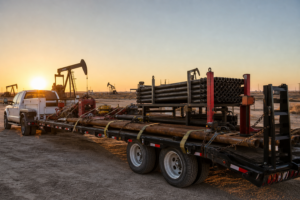
- Gooseneck flatbed trailers — Diamond C MSO and LPX series, 20 to 40 ft, rated to 25,900 lbs GVWR
- Gooseneck equipment trailers — Iron Bull and Kaufman models, 20 to 30 ft, up to 25,900 lbs GVWR
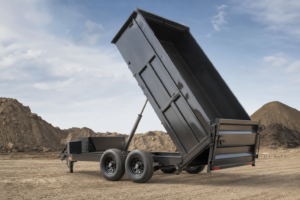
- Gooseneck dump trailers — Iron Bull 14 and 16 ft dump goosenecks, ideal for contractors hauling heavy spoil or rock
- Gooseneck car haulers — Diamond C HDT and Kaufman deluxe car haulers for transporting multiple vehicles
See our full gooseneck trailer inventory or read our bumper pull vs gooseneck comparison to decide which hitch style is right for your operation.
Texas Legal Requirements for Gooseneck Towing
Texas does not require a CDL to tow a gooseneck trailer for personal, farm, or ranch use — but there are rules. Trailers over 26,000 lbs GVWR towed commercially do require a CDL Class A. Most gooseneck trailers Trailer Place sells are between 14,000 and 25,900 lbs GVWR and fall under the non-CDL threshold for personal use.
Trailer registration in Texas is based on GVWR. Trailers over 4,500 lbs require registration with TxDMV, and electric brakes are required on any trailer over 4,500 lbs GVWR. Read our full Texas trailer registration and title guide for complete details.
Ready to Find Your Next Gooseneck Trailer?
Trailer Place is a family-owned dealership in Wharton, TX (moving to Rosenberg mid-2026), serving ranchers, contractors, farmers, and haulers across Texas and Louisiana. We carry Diamond C, Iron Bull, Kaufman, Calico, W-W, and our own in-house STAR brand galvanized cattle trailers. Financing is available for all credit situations, and we ship nationwide.
Call us at (979) 532-1486 to talk through which gooseneck trailer and hitch setup is right for your truck and your work. We are here to help you haul heavy, haul safe, and get the job done.