When you’re hauling heavy equipment in Texas, the connection between your truck and trailer matters more than most people realize. Two popular options stand out for serious haulers: the pintle hitch and the gooseneck. Each has real advantages, and choosing the wrong one for your operation can cost you in safety, efficiency, and legal compliance.
At Trailer Place in Wharton, TX, we work with contractors, ranchers, and equipment operators every day who ask this exact question. Here’s what you need to know to make the right call.
What Is a Pintle Hitch?
A pintle hitch is a hook-and-loop coupling system used primarily on commercial, military, and heavy construction equipment. The pintle hook on the truck engages a lunette ring (also called a ball ring) on the trailer tongue. The connection is loose by design — it allows more vertical and horizontal articulation than a conventional hitch, which is ideal for off-road, uneven terrain, and heavy-load applications.
Pintle hitches are common on:
- Military and government trailers
- Large lowboy and equipment trailers rated 30,000–120,000 lb GVWR
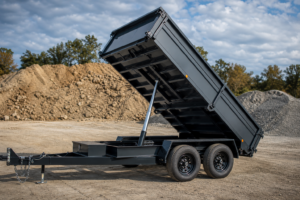
- Off-road dump trailers
- Trailers that frequently travel on rough, unpaved jobsite roads
- Commercial flatbeds used by road construction crews
What Is a Gooseneck Hitch?
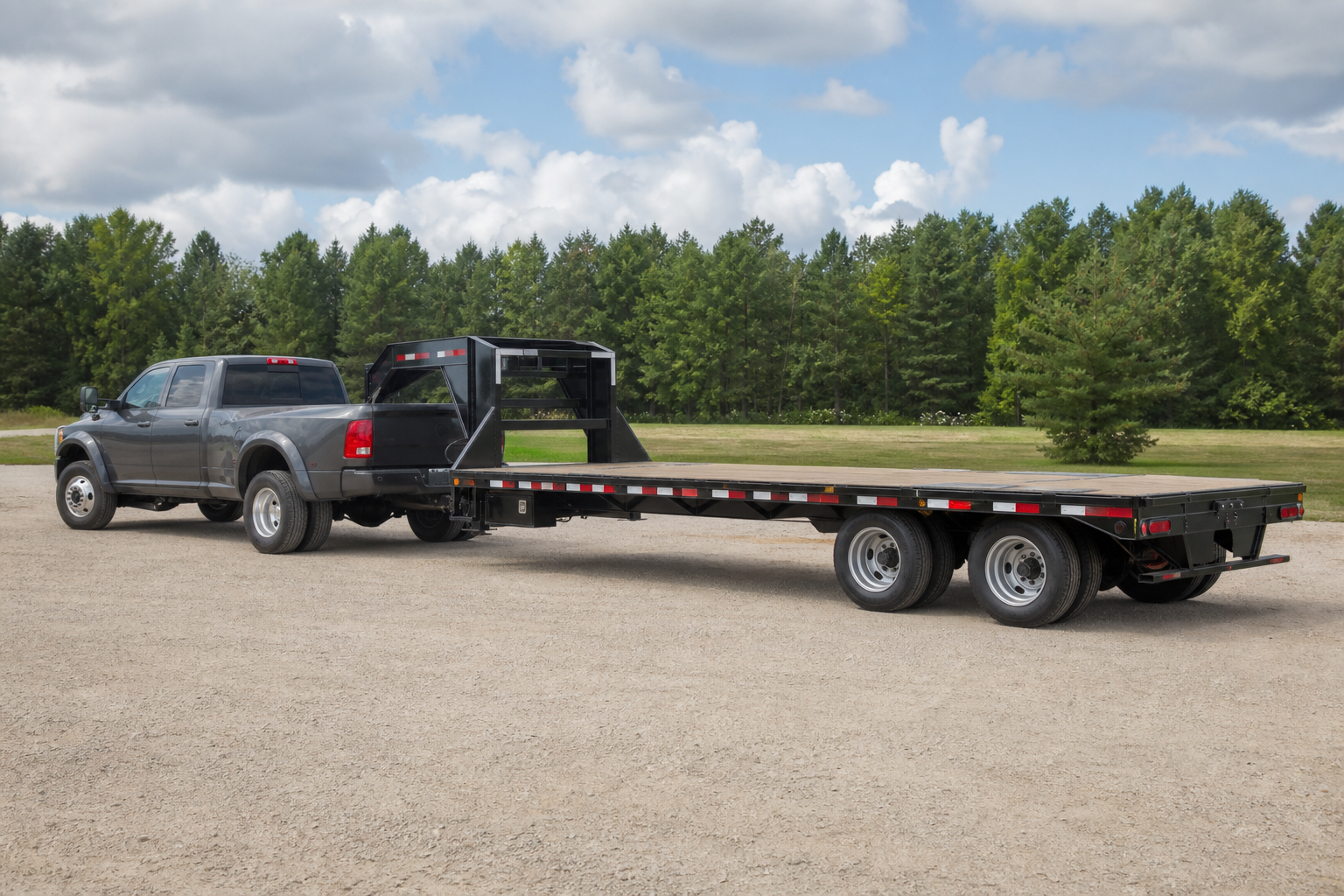
A gooseneck hitch uses a ball mounted in the truck bed (usually 2-5/16 inch) and a vertical coupler on the trailer’s gooseneck neck. Unlike a conventional bumper pull that attaches at the rear receiver, a gooseneck connection point sits directly over the truck’s rear axle. This dramatically improves weight distribution and stability, allowing you to haul significantly heavier loads than any bumper pull setup.
Gooseneck trailers are the standard choice for:
- Equipment trailers hauling skid steers, excavators, and mini loaders
- Flatbed trailers for heavy steel, lumber, and building materials
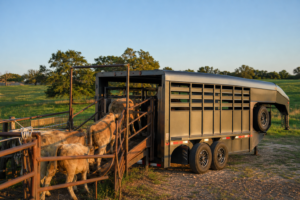
- Livestock trailers and cattle goosenecks from 20 to 40 feet
- Gooseneck trailers in the 14,000 to 30,000 lb GVWR range
- Car haulers and enclosed cargo trailers in long lengths
Pintle Hitch vs Gooseneck: Head-to-Head Comparison
| Feature | Pintle Hitch | Gooseneck |
|---|---|---|
| Connection Point | Rear receiver or frame mount | In-bed ball over rear axle |
| Typical Capacity | 30,000–120,000+ lb | 14,000–30,000 lb (most trailers) |
| Articulation | High (3-axis movement) | Moderate (pivot at ball) |
| Stability at Speed | Moderate (some rattle/play) | Excellent (low center of gravity) |
| Common Use | Heavy construction, military, off-road | Farming, ranching, equipment hauling |
| Trailer Types | Lowboys, RGNs, heavy flatbeds | Equipment, livestock, flatbed, car hauler |
| Truck Modification | Pintle mount or receiver insert | In-bed ball installation (B&W, Reese) |
| Noise When Empty | More (loose coupling) | Less (solid ball engagement) |
| Street Legal (TX) | Yes (with proper lighting) | Yes |
When to Choose a Pintle Hitch in Texas
Choose a pintle hitch if you’re operating in extreme conditions where the trailer needs to flex independently of the truck. This is most common in:
- Oil field and pipeline work on rough lease roads where terrain changes fast
- Road construction crews moving equipment over broken pavement and caliche
- Military or government contracts requiring pintle-compatible equipment
- RGN and lowboy trailers hauling bulldozers, cranes, and oversized machinery
The extra articulation of a pintle hitch prevents binding on uneven terrain that could snap a rigid gooseneck connection. If your work takes you off-road regularly, pintle is the right call.
When to Choose a Gooseneck for Equipment Hauling
For the vast majority of Texas contractors, ranchers, and small-to-mid-size operators, a gooseneck trailer is the better choice. Here’s why:
- Better highway stability — The over-axle ball placement keeps the trailer stable at 60–70 mph on Texas highways
- Quieter ride — No loose-coupling rattle on paved roads
- More trailer options — The overwhelming majority of equipment trailers, flatbeds, and livestock trailers are built gooseneck
- Lower cost — Gooseneck trailers are more widely manufactured and competitively priced
- Easier to find qualified hitches — B&W and Reese gooseneck balls are available at every truck stop and dealer in Texas
At Trailer Place, brands like Iron Bull, Diamond C, and Kaufman all manufacture excellent gooseneck equipment trailers from 20,000 to 25,900 lb GVWR that handle nearly any Texas jobsite load.
What Truck Do You Need for Each?
Both systems require a capable truck, but requirements differ:
For gooseneck trailers up to 30,000 lb GVWR, most operators use:
- Ford F-350 or F-450 (diesel, dually preferred for loads over 20,000 lb)
- Ram 3500 or 4500 (Cummins diesel)
- Chevy Silverado 3500HD or 4500HD (Duramax diesel)
For pintle hitch applications over 30,000 lb, you’re typically in commercial truck territory — CDL-class vehicles, Class 7 or 8 trucks, not pickup trucks.
Remember: if your combination (truck + trailer + load) exceeds 26,000 lb GVWR, you may need a CDL in Texas. Check out our post on whether you need a CDL in Texas for more detail.
Can You Convert Between Pintle and Gooseneck?
Sort of. There are pintle-to-gooseneck adapter rings that let a gooseneck trailer couple to a pintle hitch in some configurations, but this approach has limitations and is not recommended for heavy, high-speed applications. For most buyers, it’s better to choose the right hitch type from the start based on the trailer you plan to run.
If you’re unsure, our team can walk you through the trailer specs, recommend the right hitch setup, and help you find the right truck-trailer combination for your Texas operation.
Shop Heavy Equipment Trailers at Trailer Place
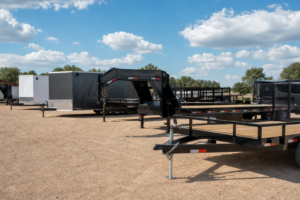
Trailer Place carries a full lineup of gooseneck-ready equipment trailers from trusted brands including Iron Bull, Diamond C, and Kaufman — all stocked near Houston in Wharton, TX, with a move to Rosenberg coming in mid-2026. Whether you’re hauling a 30,000 lb excavator or a track skid steer, we’ll match you with the right trailer for your setup.
- Browse our equipment trailers for sale
- See our gooseneck trailers inventory
- Compare flatbed trailers for heavy loads
- Read: Flatbed vs Equipment Trailer: Which Do You Need?
- Read: Gooseneck vs Bumper Pull for Equipment: Full Guide
Financing is available for qualified buyers, and we ship trailers nationwide. Call us at (979) 532-1486 or stop by — family-owned and ready to help you haul smarter.