If you have shopped for a new trailer lately, you have probably seen “torsion axle” and “leaf spring axle” listed in the spec sheet without much explanation. Both setups will get your load down the road, but they ride, wear, and cost differently — and picking the wrong one for your use case can mean a rougher tow or an unexpected repair bill down the line. Here is what actually separates the two, so you can choose with confidence.
How Each Axle Type Works
Leaf spring axles use stacked steel leaves mounted above or below the axle beam, connected to the frame with shackles and hangers. It is the older, simpler design — easy to inspect, easy to repair with parts available at almost any trailer supply shop, and it has been the standard on utility trailers and equipment trailers for decades.
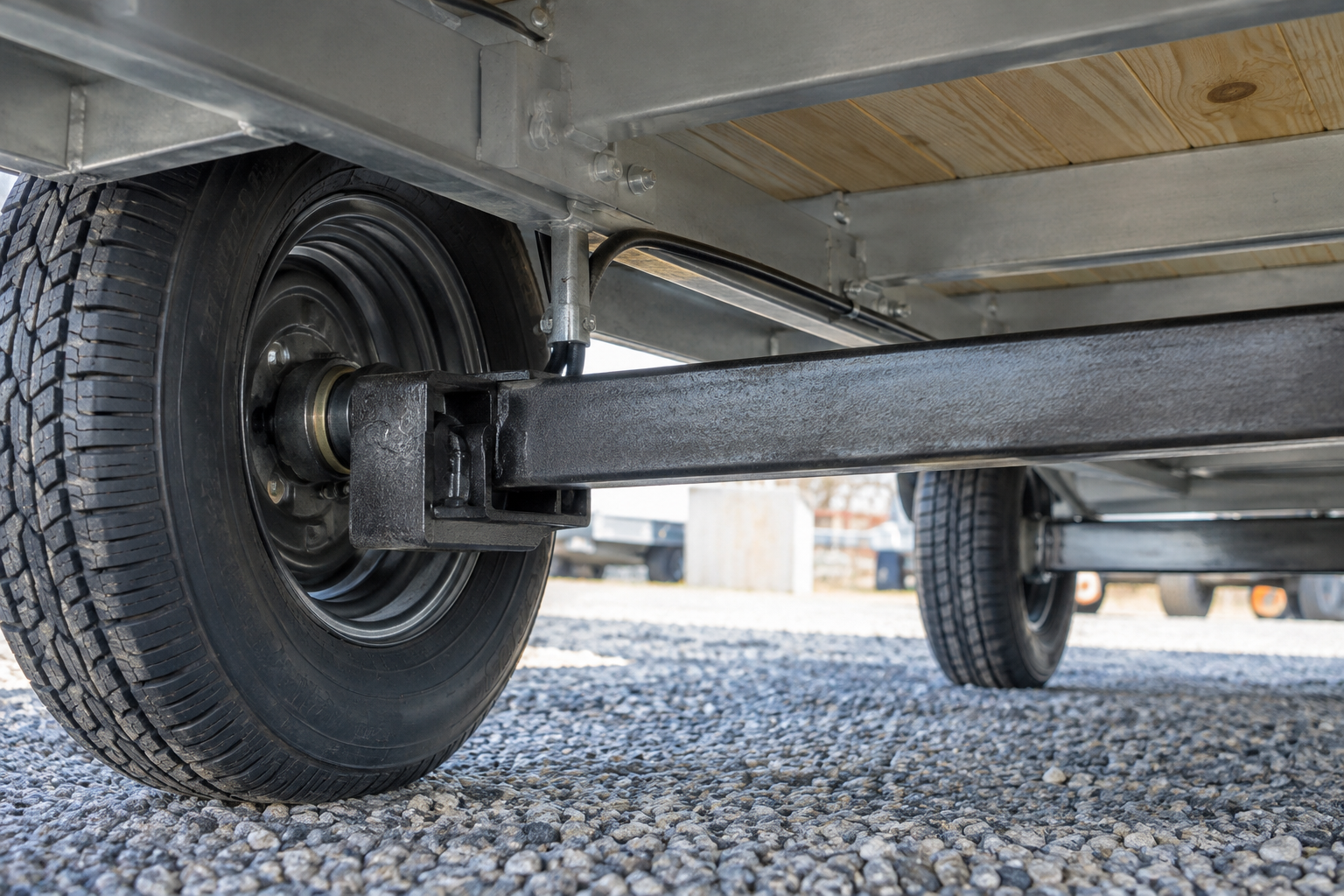
Torsion axles replace the leaf springs with a rubber cord suspension sealed inside a square axle tube. Each wheel flexes independently, which smooths out the ride and eliminates squeaky, rusting metal-on-metal spring components. Torsion axles have become the go-to on enclosed cargo trailers and car haulers where cargo protection and a smoother ride matter more.
Ride Quality and Towing Feel
Torsion axles win here for most owners. Independent suspension on each wheel means less bounce over rough Texas farm roads and highway expansion joints, which matters if you are hauling anything fragile — furniture in a moving trailer, ATVs, or livestock that gets stressed by a rough ride. Leaf springs transmit more shock into the frame and cargo, but that stiffness is actually an advantage for very heavy, rigid loads like skid steers or dump trailer payloads where you want predictable flex under max GVWR, not a springy ride.
Maintenance and Repair Cost
Leaf springs need periodic greasing of the shackles and hangers, and the u-bolts should get checked for looseness once or twice a year. When something wears out, replacement leaf spring kits are cheap and available almost everywhere, and a competent shop can swap them in an afternoon.
Torsion axles are close to maintenance-free for the first several years — there is nothing to grease and no metal springs to rust or squeak. The tradeoff is that when the rubber cords do wear out (usually well past 10 years or tens of thousands of miles for most owners), the whole axle assembly typically needs replacing rather than a simple parts swap, and torsion axles cost more upfront than leaf spring axles of the same capacity.
Ground Clearance and Ramp Angle
Torsion axles typically sit a little higher off the ground than an equivalent leaf spring setup, which is a real plus for equipment and car hauler trailers loading low-clearance machinery or lowered vehicles, and for off-road use where you need extra clearance over ruts and washouts.
Which One Should You Buy?
- Choose leaf spring if you want the lowest upfront cost, easy roadside or DIY repairs, and you are hauling heavy, rigid loads like construction equipment or scrap where ride comfort is not a priority.
- Choose torsion if you are hauling anything sensitive to vibration — livestock, household goods, ATVs/UTVs, or vehicles — and you want a quieter, smoother tow with less long-term squeak and rust.
Many of our Diamond C and Iron Bull models are available with either axle type depending on the trailer, and our in-house STAR brand livestock trailers are built with axle configurations suited to the loads they are designed to carry. If you are also deciding between a single or tandem axle setup, our single vs. tandem axle guide breaks down that decision too, and understanding how axle type interacts with load capacity is easier once you have read our GVWR and payload guide.
Not sure which axle setup fits your specific hauling needs? Our team at Trailer Place in Wharton, TX (moving to Rosenberg mid-2026) can walk you through the options in person or over the phone, and we offer financing and nationwide shipping on every trailer we stock. Call us at (979) 532-1486 to talk through your options with a real trailer expert — no pressure, just straight answers.