- Car flippers and repo haulers loading non-running vehicles onto a car hauler
- Ranchers and hunters pulling ATVs and UTVs onto a utility or equipment trailer
- Equipment operators loading skid steers, mowers, or mini excavators that need an assist on wet or muddy ramps
- Anyone hauling a disabled vehicle for towing or recovery work
If everything you haul drives itself onto the trailer under its own power, a winch is a nice-to-have, not a must-have. But most working trailers in Texas end up loading at least one dead vehicle or stuck piece of equipment a year, and that is when a winch pays for itself in a single use.
Electric vs. Manual (Hand Crank) Winches
Manual hand-crank winches are the standard on most car hauler and utility trailers straight from the factory. They are inexpensive (often $60-150 for a quality unit), never fail due to a dead battery, and work fine for occasional light-duty pulls of 2,000-3,500 lbs. The tradeoff is arm strength and time — winching a full-size sedan up an 18-foot ramp by hand is a real workout.
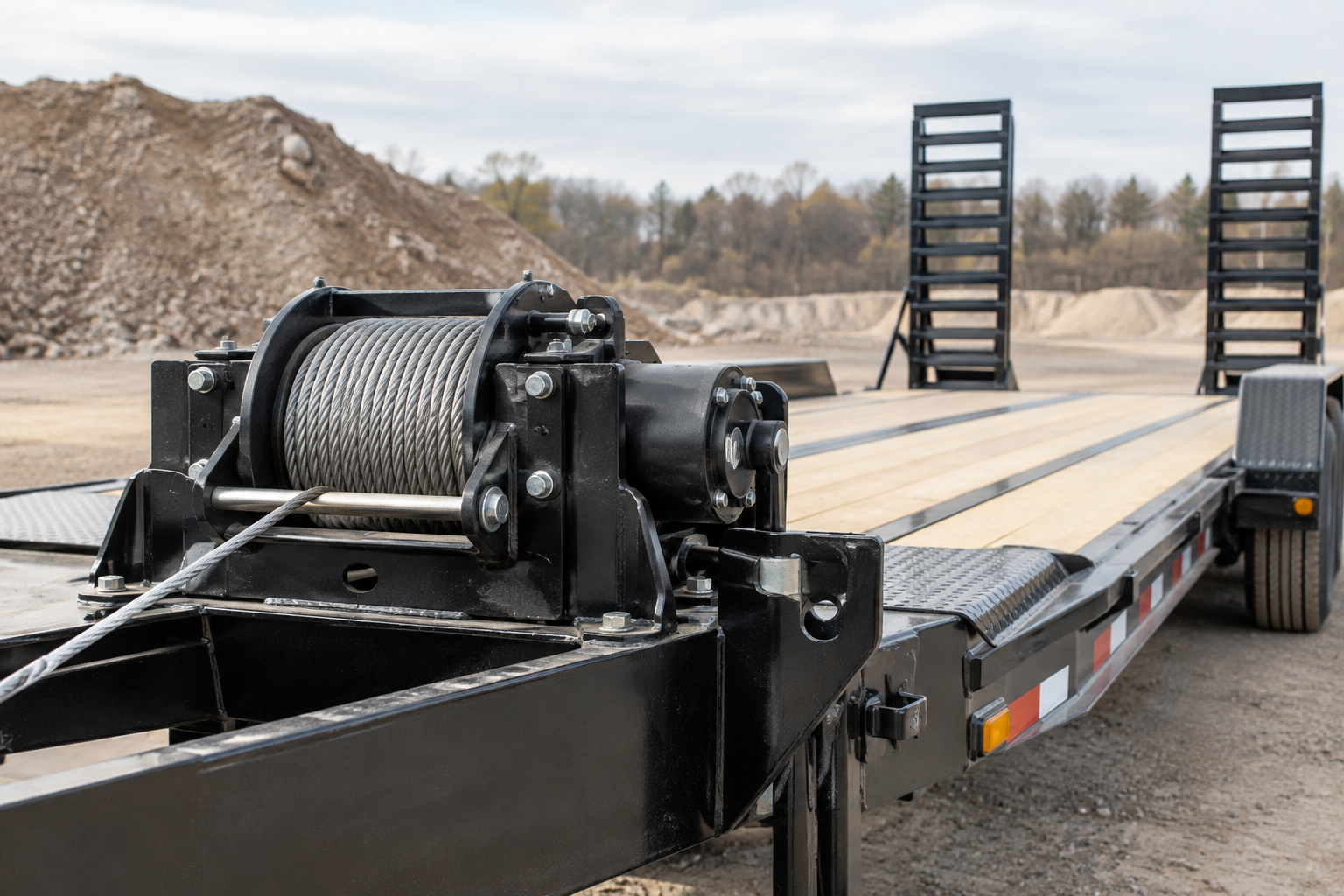
Electric winches (12V DC, powered off the tow vehicle battery or a dedicated trailer battery) run $150-500 depending on pulling capacity and typically handle 3,500-9,500 lbs. They are the right call for repo work, frequent non-running vehicle loads, or any equipment trailer regularly pulling stuck skid steers and compact tractors out of mud. Look for a sealed, weatherproof motor housing — Texas humidity and Gulf Coast salt air are hard on unsealed electrics.
Matching Winch Capacity to Your Load
A common rule of thumb is to size the winch to at least 1.5x the heaviest dead-weight load you expect to pull, since a stalled or stuck load creates far more resistance than its static weight suggests:
- ATVs/UTVs (500-1,200 lbs): 2,000-3,500 lb winch is plenty
- Sedans and light trucks (3,000-4,500 lbs): 4,500-6,000 lb electric winch recommended
- Full-size trucks, SUVs, and small equipment (5,000-7,000 lbs): 8,000-9,500 lb electric winch
- Skid steers, compact tractors, mini excavators: check your Diamond C or Iron Bull equipment trailer’s GVWR and pair the winch to the heaviest single piece of equipment, not the trailer’s total capacity
Which Trailers Are Easiest to Add a Winch To
Steel-frame car haulers and flatbeds with a bolted or welded winch plate up front are the easiest retrofit. Most of our gooseneck equipment and car hauler models can be ordered with a winch mount and plate already in place — worth asking about at order time rather than retrofitting later. Aluminum trailers can be fitted too, but the mounting point needs to spread the load across the frame rather than a single rivet or bolt, so factory-installed mounts are strongly preferred over aftermarket brackets on aluminum decks.
Cost to Add a Winch
Budget $75-200 for a manual winch with mounting hardware, or $200-600 installed for a quality electric winch with a weatherproof housing, wireless remote, and dedicated wiring. If you are financing a new trailer through our financing program, a winch and mounting plate can typically be rolled into the build sheet for a small increase in the monthly payment rather than paid out of pocket after delivery.
Talk to Trailer Place About Your Build
Whether you need a car hauler with a heavy-duty electric winch for repo work, a single or tandem axle equipment trailer for skid steers, or just want to add a hand-crank winch to your current utility trailer, our team at Trailer Place in Wharton, TX (moving to Rosenberg mid-2026) can spec the right winch and mount for your trailer and your loads. We serve customers across Texas and Louisiana with financing, nationwide shipping, and our in-house STAR brand manufacturing.
Call us at (979) 532-1486 to talk through your winch options, or browse our current inventory of car hauler, flatbed, and equipment trailers online.
If you haul ATVs, UTVs, mowers, disabled vehicles, or heavy equipment, a trailer winch can save you time, your back, and a trip to the ER. But not every trailer needs one, and not every winch is built the same. Here is what Texas and Louisiana trailer buyers need to know before adding a winch to a flatbed, utility, or car hauler trailer.
Who Actually Needs a Trailer Winch
A winch earns its keep any time you are loading something that cannot drive itself up a ramp. That covers a lot of ground:
- Car flippers and repo haulers loading non-running vehicles onto a car hauler
- Ranchers and hunters pulling ATVs and UTVs onto a utility or equipment trailer
- Equipment operators loading skid steers, mowers, or mini excavators that need an assist on wet or muddy ramps
- Anyone hauling a disabled vehicle for towing or recovery work
If everything you haul drives itself onto the trailer under its own power, a winch is a nice-to-have, not a must-have. But most working trailers in Texas end up loading at least one dead vehicle or stuck piece of equipment a year, and that is when a winch pays for itself in a single use.
Electric vs. Manual (Hand Crank) Winches
Manual hand-crank winches are the standard on most car hauler and utility trailers straight from the factory. They are inexpensive (often $60-150 for a quality unit), never fail due to a dead battery, and work fine for occasional light-duty pulls of 2,000-3,500 lbs. The tradeoff is arm strength and time — winching a full-size sedan up an 18-foot ramp by hand is a real workout.
Electric winches (12V DC, powered off the tow vehicle battery or a dedicated trailer battery) run $150-500 depending on pulling capacity and typically handle 3,500-9,500 lbs. They are the right call for repo work, frequent non-running vehicle loads, or any equipment trailer regularly pulling stuck skid steers and compact tractors out of mud. Look for a sealed, weatherproof motor housing — Texas humidity and Gulf Coast salt air are hard on unsealed electrics.
Matching Winch Capacity to Your Load
A common rule of thumb is to size the winch to at least 1.5x the heaviest dead-weight load you expect to pull, since a stalled or stuck load creates far more resistance than its static weight suggests:
- ATVs/UTVs (500-1,200 lbs): 2,000-3,500 lb winch is plenty
- Sedans and light trucks (3,000-4,500 lbs): 4,500-6,000 lb electric winch recommended
- Full-size trucks, SUVs, and small equipment (5,000-7,000 lbs): 8,000-9,500 lb electric winch
- Skid steers, compact tractors, mini excavators: check your Diamond C or Iron Bull equipment trailer’s GVWR and pair the winch to the heaviest single piece of equipment, not the trailer’s total capacity
Which Trailers Are Easiest to Add a Winch To
Steel-frame car haulers and flatbeds with a bolted or welded winch plate up front are the easiest retrofit. Most of our gooseneck equipment and car hauler models can be ordered with a winch mount and plate already in place — worth asking about at order time rather than retrofitting later. Aluminum trailers can be fitted too, but the mounting point needs to spread the load across the frame rather than a single rivet or bolt, so factory-installed mounts are strongly preferred over aftermarket brackets on aluminum decks.
Cost to Add a Winch
Budget $75-200 for a manual winch with mounting hardware, or $200-600 installed for a quality electric winch with a weatherproof housing, wireless remote, and dedicated wiring. If you are financing a new trailer through our financing program, a winch and mounting plate can typically be rolled into the build sheet for a small increase in the monthly payment rather than paid out of pocket after delivery.
Talk to Trailer Place About Your Build
Whether you need a car hauler with a heavy-duty electric winch for repo work, a single or tandem axle equipment trailer for skid steers, or just want to add a hand-crank winch to your current utility trailer, our team at Trailer Place in Wharton, TX (moving to Rosenberg mid-2026) can spec the right winch and mount for your trailer and your loads. We serve customers across Texas and Louisiana with financing, nationwide shipping, and our in-house STAR brand manufacturing.
Call us at (979) 532-1486 to talk through your winch options, or browse our current inventory of car hauler, flatbed, and equipment trailers online.