When you’re buying a trailer in Texas, one of the most important decisions you’ll make is what kind of braking system you need. Electric brakes and surge brakes are the two most common options, and choosing the wrong one can mean failed inspections, dangerous towing, or compatibility headaches with your truck. This guide breaks down everything you need to know so you can buy with confidence.
Why Trailer Brakes Matter
Texas law requires brakes on trailers with a Gross Vehicle Weight Rating (GVWR) over 4,500 lbs. Once your loaded trailer hits that threshold, you must have functioning trailer brakes or you’re out of compliance — and more importantly, you’re creating a serious safety hazard. A 10,000 lb loaded dump trailer pushing your truck at 70 mph on I-10 is not something to take lightly.
Both electric and surge brake systems are approved for use in Texas. The right choice depends on your trailer type, tow vehicle, and how you use it.
What Are Electric Trailer Brakes?
Electric trailer brakes use an electromagnet to activate brake shoes inside the trailer’s drum brakes. When you press the brake pedal in your truck, a brake controller (installed in the cab) sends an electric signal to the trailer’s brakes, causing them to apply in sync with your truck’s brakes.
How Electric Brakes Work
- Your truck needs a brake controller installed — either a factory-built-in unit (common on modern trucks) or an aftermarket controller
- The controller sends a proportional or timed signal through the trailer wiring harness
- The electromagnet activates, engaging the drum brakes on the trailer axles
- Most brake controllers let you adjust brake sensitivity for load weight and road conditions
Pros of Electric Brakes
- Precise control — you can adjust braking force from the cab
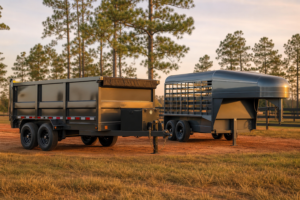
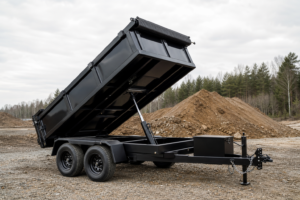
- Standard on most work trailers — dump trailers, equipment trailers, gooseneck trailers, and car haulers almost always use electric brakes
- Works at any speed — does not require momentum to activate (unlike surge brakes)
- Required for trailers over 4,500 lbs GVWR in Texas when towing on public roads
- Better for heavy loads — more reliable on 10,000 lb+ trailers
Cons of Electric Brakes
- Requires a brake controller in the tow vehicle — older trucks may need one installed
- Requires proper 7-pin wiring connection between truck and trailer
- If the wiring or controller fails, you lose trailer braking entirely
What Are Surge Brakes?
Surge brakes (also called hydraulic surge brakes) activate using the trailer’s own forward momentum. A coupler mechanism at the hitch compresses when the trailer pushes into the tow vehicle during braking, which activates a hydraulic master cylinder and applies the trailer’s drum or disc brakes automatically.
How Surge Brakes Work
- No wiring connection needed from the tow vehicle (beyond lights)
- The coupler has a sliding mechanism — when you slow down, the trailer pushes forward and compresses the coupler
- That compression drives hydraulic fluid to the trailer’s brakes
- Braking force is proportional to how hard the trailer is pushing — harder deceleration means more brake force
Pros of Surge Brakes
- No brake controller needed — works with any tow vehicle
- Self-contained system — fewer wiring concerns
- Common on boat trailers and enclosed cargo trailers
- Works on vehicles that can’t accommodate a brake controller
Cons of Surge Brakes
- Cannot be used with weight distribution hitches or anti-sway bars on some setups — the coupler movement can be restricted
- Problematic for backing up — when you reverse, the coupler compresses and applies the brakes, requiring a bypass valve or pin
- Less precise — you cannot adjust braking force from the cab
- Not ideal for very heavy trailers — electric brakes handle 14,000+ lb GVWR better
- Not compatible with some rental or commercial applications that require electric brakes
Electric Brakes vs Surge Brakes: Side-by-Side Comparison
| Feature | Electric Brakes | Surge Brakes |
|---|---|---|
| Requires brake controller | Yes | No |
| Works when backing up | Yes | Requires bypass pin |
| Adjustable from cab | Yes | No |
| Best for heavy trailers | Yes | Not recommended over 10K lbs |
| Common trailer types | Dump, equipment, gooseneck, car hauler | Boat, lighter enclosed cargo |
| Wiring required | 7-pin connection | Lights only (4 or 5-pin) |
| Texas law compliance | Yes (standard) | Yes (approved) |
Which Brake System Is Right for You?
Choose Electric Brakes If:
- You’re buying a dump trailer, equipment trailer, gooseneck trailer, or car hauler
- Your trailer has a GVWR over 6,000 lbs
- You have a modern truck with a built-in brake controller (most 2015+ HD trucks have this)
- You need to back the trailer frequently (construction sites, tight lots, farms)
- You want full control over braking force from the cab
Choose Surge Brakes If:
- You’re buying a boat trailer or a lighter utility trailer
- Your tow vehicle cannot accommodate a brake controller
- You rarely need to back up (lake launches aside)
- Your trailer GVWR is under 7,000 lbs
Brake Controllers: What Your Truck Needs for Electric Brakes
If your truck doesn’t already have a factory brake controller, you’ll need to install an aftermarket unit. Common options include proportional controllers (which sense deceleration force and match trailer braking to truck braking) and time-delayed controllers (which apply a preset braking signal after a delay). Most trailer buyers find proportional controllers provide smoother, safer stops.
Modern 3/4-ton and 1-ton trucks — like the Ram 2500, Chevy Silverado 3500HD, and Ford F-350 — come with integrated brake controllers from the factory. If you’re driving a half-ton or an older truck, check your owner’s manual or ask us and we can point you in the right direction.
What Do the Trailers at Trailer Place Use?
Almost every work trailer we carry uses electric brakes:
- Diamond C dump, equipment, flatbed, and gooseneck trailers — all electric brakes
- Iron Bull dump and equipment trailers — electric brakes standard
- Livestock trailers — electric brakes standard on most models
- Our in-house STAR galvanized cattle trailers — electric brakes
- Car hauler trailers — electric brakes standard
If you’re shopping for a utility trailer or smaller cargo trailer under 4,500 lbs GVWR, surge or no brakes may apply depending on the model. Our team can walk you through exactly what’s on any trailer in our lot.
Get the Right Trailer with the Right Brakes
At Trailer Place in Wharton, TX, we help buyers make smart decisions — not just about which trailer to buy, but about exactly how it’s equipped. Whether you need a 14,000 lb dump trailer with electric brakes for a construction crew or a lighter enclosed cargo trailer, we’ll help you match the right braking system to your needs and your truck.
We carry dump trailers, equipment trailers, gooseneck trailers, flatbed trailers, livestock trailers, and more — all from top brands like Diamond C, Iron Bull, and our own STAR brand. Financing is available, and we ship nationwide.
Call us at (979) 532-1486 or stop by our lot in Wharton, TX to talk through your trailer needs. We’re a family-owned dealership and we’re here to help you get the right setup — brakes and all.