How to Load and Secure Equipment on a Trailer: A Step-by-Step Guide
Loading equipment onto a trailer sounds straightforward — until your skid steer shifts on the highway, or a ratchet strap snaps because it was rated for the wrong weight. Getting it right matters for safety, your equipment, other drivers, and Texas law. This guide walks you through the entire process from positioning your trailer to final pre-departure checks.
Step 1: Match Your Trailer to the Load
Before you even start loading, make sure your trailer can handle what you’re putting on it. Check three numbers:
- GVWR (Gross Vehicle Weight Rating) — the maximum combined weight of the trailer and everything on it
- Payload capacity — GVWR minus the trailer’s empty weight (curb weight)
- Axle ratings — each axle has its own rating; total axle ratings must equal or exceed GVWR
A common mistake is confusing GVWR with payload. A 14,000 lb GVWR equipment trailer that weighs 3,200 lbs empty only has 10,800 lbs of payload capacity. If your excavator weighs 11,500 lbs, you need a heavier trailer. Check out our full guide on trailer GVWR, payload, and tongue weight if you need a refresher.
Step 2: Prepare the Trailer Before Loading
A few minutes of prep saves a lot of headaches:
- Level the trailer — if your truck is hitched, make sure the trailer deck is as close to level as possible. A nose-high trailer creates loading angle problems and shifts tongue weight.
- Chock the trailer wheels — use wheel chocks front and rear so the trailer cannot roll while you’re loading.
- Inspect ramps — check that loading ramps are fully seated and locked before running equipment up them. A ramp that pops loose mid-load can flip a machine.
- Clean the deck — mud, gravel, and debris on a steel deck are slippery and can interfere with tie-down straps.
Step 3: Position Equipment Correctly on the Deck
Weight distribution is the most important factor in safe towing. The general rule: 60 percent of the load weight should be in the front half of the trailer deck, with 40 percent toward the rear. This keeps enough tongue weight on the hitch without overloading it.
Tongue weight should be 10-15 percent of total trailer weight for bumper pull trailers, or 15-25 percent for gooseneck setups. Too little tongue weight causes trailer sway at highway speed — one of the most dangerous towing conditions. Too much overloads your hitch and affects your tow vehicle’s steering.
For single-piece loads like a skid steer or mini excavator:
- Center the equipment side-to-side on the deck
- Position it so the heavier end (typically the engine/counterweight) is toward the front of the trailer
- Leave clearance at the rear so ramps can be stowed properly
For multiple pieces or mixed loads, put the heaviest items forward and low, lighter items toward the rear.
Step 4: Choose the Right Tie-Downs
Tie-down straps are rated by Working Load Limit (WLL) — the maximum force the strap is designed to hold in normal use. Federal regulations (FMCSA) and common sense both require enough straps to secure your load. The general rule: total WLL of all tie-downs must equal at least half the weight of the load.
For a 10,000 lb skid steer, you need straps with a combined WLL of at least 5,000 lbs. Four 2-inch ratchet straps rated at 3,333 lbs WLL each (total 13,332 lbs WLL) is standard practice for peace of mind.
Common strap types for equipment:
- 2-inch ratchet straps — 3,300-5,000 lb WLL, good for UTVs, ATVs, lighter equipment
- 4-inch ratchet straps — 5,000-10,000 lb WLL, standard for excavators, skid steers, large mowers
- Chain binders — used for heavy equipment over 20,000 lbs; chains rated to Grade 70 or Grade 80
- Axle straps — loop around axle housings on wheeled equipment; avoids stress on painted surfaces
Avoid using hooks directly on sheet metal, brake lines, fuel lines, or hydraulic hoses. Always attach to structural points: axles, frames, lift arms, or factory tie-down rings.
Step 5: Secure the Load — Front, Rear, and Sides
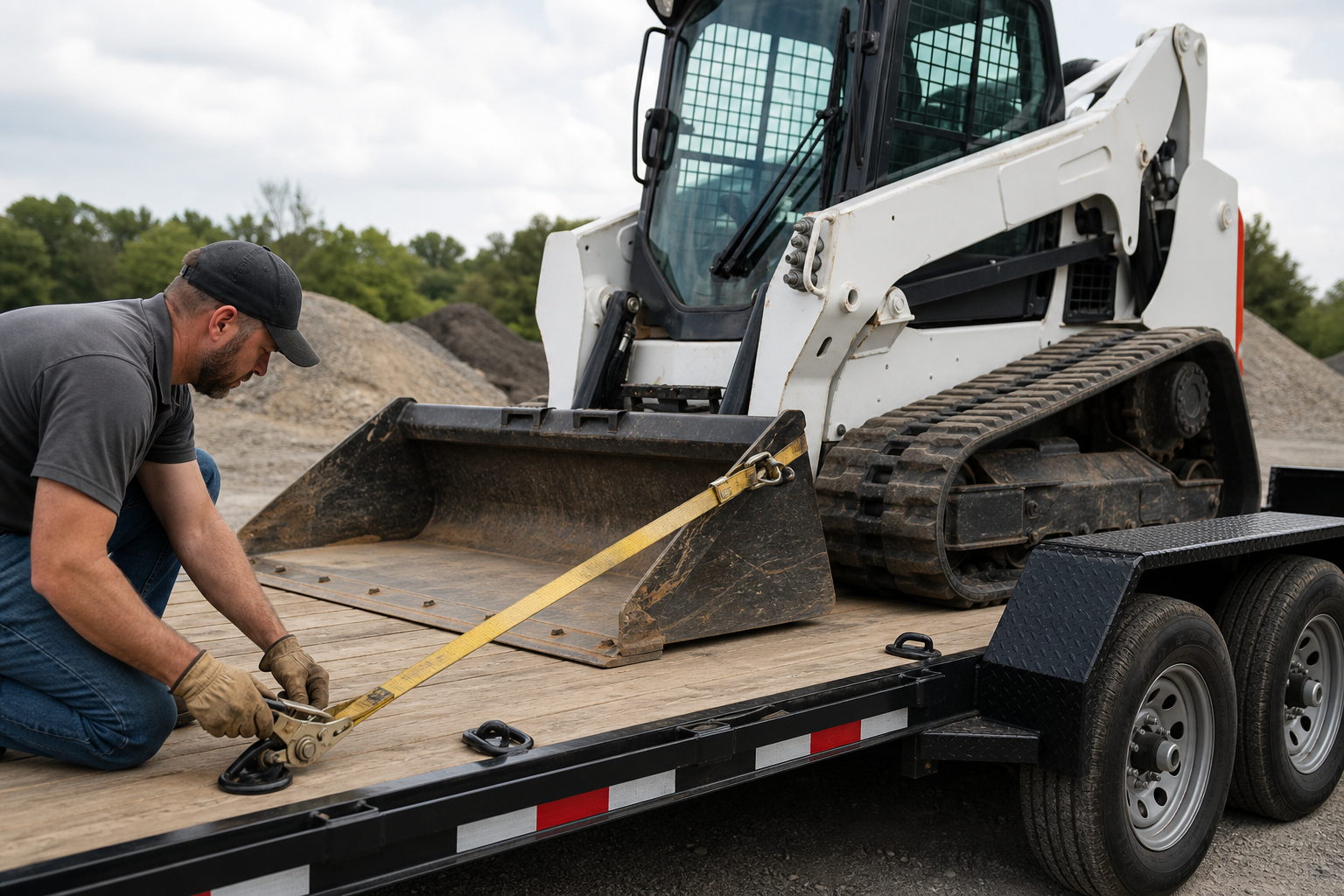
The standard tie-down pattern for wheeled or tracked equipment is an X-pattern with four straps:
- Front-left strap: from front-left of equipment to front-left D-ring on trailer
- Front-right strap: from front-right of equipment to front-right D-ring
- Rear-left strap: from rear-left of equipment to rear-left D-ring, angling forward
- Rear-right strap: from rear-right of equipment to rear-right D-ring, angling forward
Straps should angle at roughly 45 degrees when possible — too flat reduces holding power; too vertical can tip the equipment. After ratcheting tight, make sure the equipment does not rock or shift when you push on it by hand.
For tracked equipment like mini excavators, lock the blade down to the deck or a front D-ring to prevent the blade from being used as a lever during hard braking. Pin the boom in transport position and lower the bucket or attachment to the deck.
Step 6: Check Height Clearances
Texas has a maximum load height of 14 feet for vehicles without a permit. If your trailer sits 24 inches off the ground and your equipment is 10 feet tall, your total height is just under the limit — but add an attachment, raised bucket, or ROPS and you may go over.
Always measure total loaded height before leaving the yard, especially with excavators with booms that do not fold completely flat. Check your route for low bridges, power lines at job site entrances, and overhead structures.
Step 7: Final Pre-Departure Checklist
Before pulling onto the road, walk around the whole rig and verify:
- All ratchets are tight and straps are taut (no slack)
- Strap hooks are fully seated in D-rings
- No straps are riding on sharp edges or rubbing points that could cut them
- Ramps are stowed and locked (not bouncing loose)
- Trailer lights are working — brake lights, turn signals, running lights
- Safety chains are crossed under the tongue and connected
- Breakaway cable is attached to tow vehicle (required in Texas)
- Electric brake controller is activated and set to load weight
Pull out slowly and stop after a quarter mile to re-check strap tension. Vibration and movement can cause straps to loosen on the first stretch of road. Re-tighten as needed.
Trailer Types Best Suited for Equipment Hauling
Not all trailers are built the same for equipment transport. The right trailer makes loading and securing equipment easier and safer:
- Equipment trailers — purpose-built for skid steers, excavators, and telehandlers; typically 10,000-22,000 lb GVWR with heavy D-rings and low deck height
- Flatbed trailers — versatile for mixed loads including pipe, lumber, and equipment; work with both ramps and cranes
- Tilt trailers — the deck tilts to create a drive-on ramp angle, ideal for low-clearance equipment and faster loading
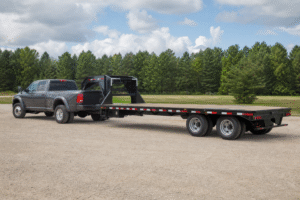
- Gooseneck trailers — for the heaviest loads; 22,000-30,000+ lb GVWR, more stable tongue weight distribution for one-ton trucks
Brands like Iron Bull, Diamond C, and Kaufman all build heavy-duty equipment trailers with thick decking, multiple D-ring locations, and ramp systems engineered for real-world use. Learn more in our Iron Bull vs Diamond C equipment trailer comparison and our flatbed vs equipment trailer guide.
Need Help Choosing the Right Trailer?
Trailer Place is a family-owned dealership in Wharton, TX serving contractors, ranchers, and business owners across Texas and Louisiana. We carry equipment trailers, tilt trailers, gooseneck trailers, and flatbeds from top brands — and we’ll help you match the right trailer to the equipment you’re hauling.
Call us at (979) 532-1486 or browse our equipment trailer inventory online. Financing available, nationwide shipping, and in-house service. We’ll get you set up right.