What Size Trailer Do I Need? Complete Sizing Guide
Buying a trailer that’s too small means multiple trips and lost productivity. Buying one that’s
too big wastes money on capacity you don’t need, uses more fuel, and may exceed your truck’s
towing capacity. Here’s how to find the right size trailer for your specific use case, from
the experts at Trailer Place.
Step 1: Know Your Truck’s Towing Capacity
Before choosing a trailer, check your truck’s maximum tow rating (found in the owner’s manual
or on the driver’s door jamb sticker). Your loaded trailer weight must stay under this number.
General guidelines:
- Half-ton trucks (F-150, Silverado 1500, RAM 1500): 8,000-13,000 lbs towing capacity
- 3/4-ton trucks (F-250, Silverado 2500, RAM 2500): 14,000-20,000 lbs
- 1-ton trucks (F-350, Silverado 3500, RAM 3500): 18,000-37,000 lbs
- SUVs (Tahoe, Expedition, Suburban): 7,000-9,000 lbs
Step 2: Match Trailer Size to Your Use
Homeowner / Personal Use
- Yard work, small moves: 5’x8′ or 5’x10′ utility trailer (GVWR: 2,000-3,500 lbs)
- Riding mower + lawn tools: 6’x10′ or 6’x12′ utility trailer (GVWR: 2,990-5,000 lbs)
- Household junk removal: 6’x10′ dump trailer (GVWR: 7,000-10,000 lbs)
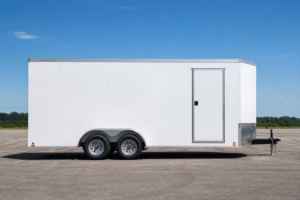
- Moving furniture: 6’x12′ enclosed trailer
- ATV/UTV hauling: 6’x12′ or 7’x14′ utility or enclosed
Landscaping
- Solo operator: 6’x12′ dump trailer
- Full crew: 7’x14′ or 7’x16′ dump trailer
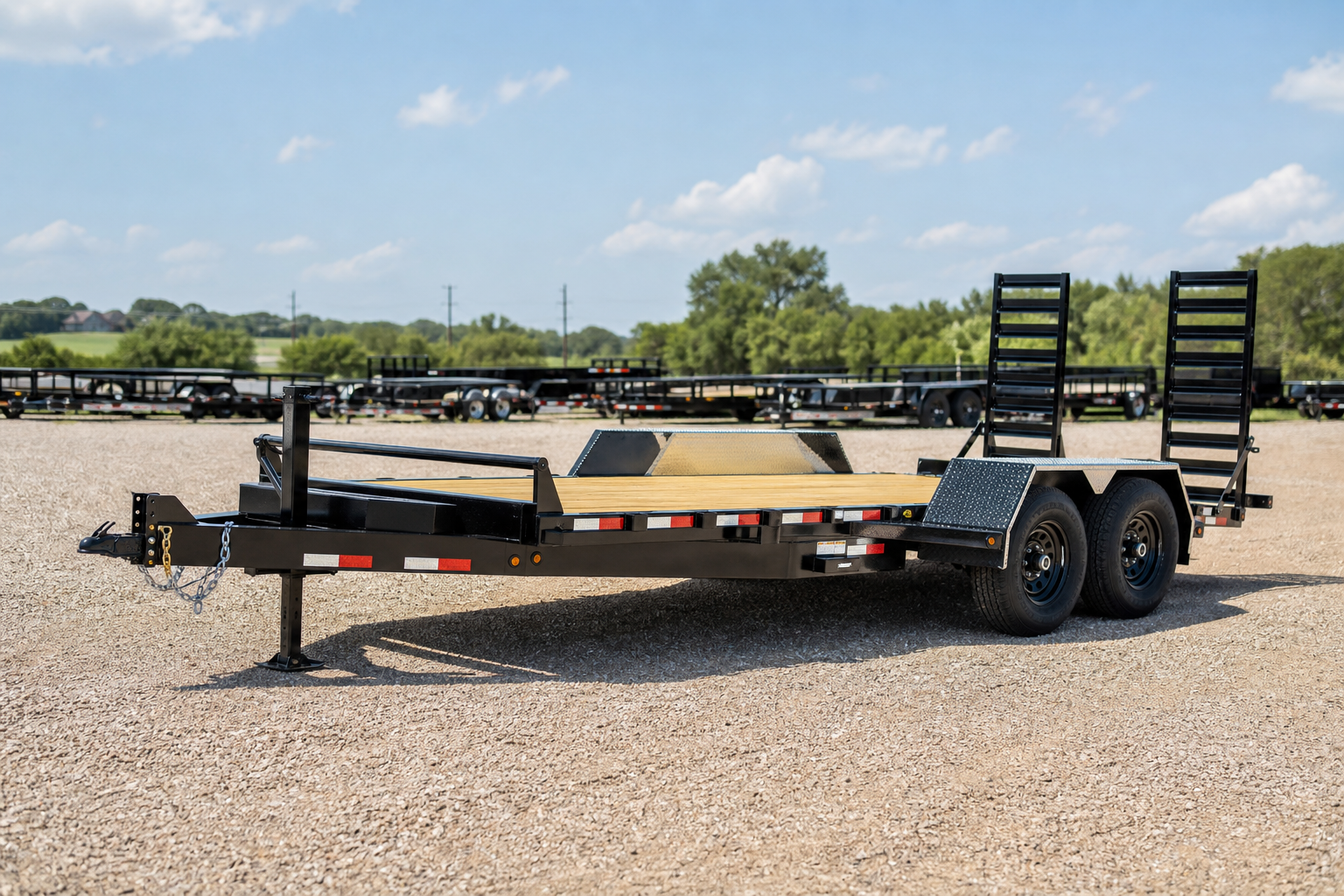
- Equipment transport: 7’x16′ or 7’x18′ equipment trailer
Construction / Contracting
- General contractor: 7’x14′ dump + 7’x16′ enclosed (tool trailer)
- Roofing: 7’x14′ dump trailer with high sides
- Demolition: 7’x16′ heavy-duty dump (14K+ GVWR)
- Heavy equipment: 7’x20′ equipment trailer or 24’+ flatbed
Ranching / Agriculture
- 5-6 head of cattle: 16′ stock trailer
- 10-12 head: 20′-24′ gooseneck stock trailer
- Hay hauling: 24′-32′ gooseneck flatbed
- Tractor transport: 20’+ equipment trailer (tilt or ramp)
Commercial Hauling / Hotshot
- Hotshot trucking: 38′-40′ gooseneck flatbed
- Car hauling: 18′-22′ car hauler
- Vehicle transport (2+ cars): 36′-40′ gooseneck car hauler
Step 3: Check the Weight Math
The most common mistake is choosing a trailer based on physical size alone. You also need to
check that your loaded weight stays within both the trailer’s GVWR and your truck’s tow rating:
Trailer empty weight + cargo weight = total loaded weight
This must be ≤ trailer GVWR AND ≤ your truck’s max tow rating.
For example: A 7’x14′ dump trailer weighs ~3,500 lbs empty with a 14,000 lb GVWR. That means
you can carry 10,500 lbs of cargo — but only if your truck can tow 14,000 lbs.
Still Not Sure? Let Us Help
Bring your truck to Trailer Place and tell us what
you’re hauling. We’ll check your tow rating, show you the right size options, and let you see
them loaded to judge the fit. 2507 County Rd 231, Wharton, TX 77488. Call (979) 532-1486.
Frequently Asked Questions
Where is Trailer Place located?
Trailer Place is located at 2507 County Rd 231, Wharton, TX 77488. We’re moving to Rosenberg, TX mid-2026. Call (979) 532-1486 for directions.
What brands does Trailer Place carry?
We carry Diamond C, Iron Bull, Alcom, Calico, Texas Pride, Aluma, Kaufman, W-W, Cargo Craft, AmeriTrail, and Star trailers. Visit us to see the full lineup.
Does Trailer Place ship trailers nationwide?
Yes, Trailer Place offers nationwide shipping on all trailers. Call (979) 532-1486 for a shipping quote to your location.
Can I finance a trailer with bad credit?
Yes. Trailer Place works with multiple lenders to offer financing options for all credit situations. Call (979) 532-1486 to discuss your options.