
Choosing the Right Truck for a 20-Foot Gooseneck
A 20-foot gooseneck trailer is one of the most versatile rigs on the market — popular with ranchers hauling cattle, contractors moving equipment, and hotshot operators running loads across Texas and beyond. But pulling one safely starts with having the right truck. If you size down, you risk overloading your vehicle, burning out your transmission, and putting yourself and others in danger on I-10 or US-59.
At Trailer Place in Wharton, TX, we sell a wide range of gooseneck trailers and we answer this question every week. Here is what you actually need.
What Does a 20-Foot Gooseneck Actually Weigh?
A standard steel 20-foot gooseneck flatbed or equipment trailer typically has a GVWR (gross vehicle weight rating) of 14,000 to 25,900 lbs, depending on the model and axle configuration. Empty trailer weight usually runs 4,200 to 6,500 lbs. Add your payload — a skid steer, cattle, vehicles, or building materials — and you can easily hit 20,000 lbs or more on the combined weight.
Common 20-ft gooseneck models we stock include:
- Diamond C MSO 20′ — GVWR 14,000 lbs, steel frame, ideal for light equipment and farm use
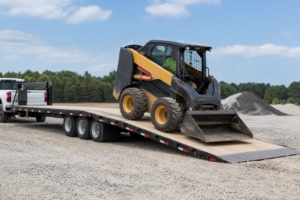
- Diamond C LPX 20′ — GVWR up to 25,900 lbs, low-profile for skid steers and mini excavators
- Iron Bull GN 20′ — GVWR 25,900 lbs, heavy-duty dual rear wheel required
- Kaufman Standard GN 20′ — GVWR 14,000-17,600 lbs, popular all-around work trailer
See our full lineup of gooseneck trailers for sale and compare options by GVWR and axle rating.
Minimum Truck Requirements for a 20-Foot Gooseneck
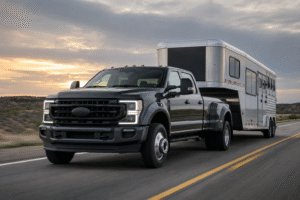
Here is the short answer: you need at minimum a 3/4-ton truck (like an F-250 or Ram 2500) for lighter gooseneck trailers, and a 1-ton dually (F-350 DRW, Ram 3500 DRW, or Silverado 3500HD DRW) for anything with a GVWR of 20,000 lbs or more.
| Truck Class | Examples | Max Gooseneck Tow Rating | Recommended For |
|---|---|---|---|
| 3/4-Ton (SRW) | F-250, Ram 2500, Silverado 2500HD | 15,000-18,500 lbs | 14,000-17,600 lb GVWR goosenecks |
| 1-Ton SRW | F-350 SRW, Ram 3500 SRW | 18,000-21,000 lbs | Light to mid-weight goosenecks |
| 1-Ton DRW (Dually) | F-350 DRW, Ram 3500 DRW, Silverado 3500HD DRW | 21,000-37,500 lbs | 25,900 lb GVWR and above |
Keep in mind that towing capacity ratings assume your truck is properly equipped — gooseneck hitch installed, brake controller wired, and trailer wiring connected. Always verify your specific truck’s Gross Combined Weight Rating (GCWR) from the door jamb sticker or owner’s manual before hooking up.
Why Payload Matters as Much as Towing Capacity
Most buyers focus on towing capacity and overlook payload — the amount of weight your truck bed and rear axle can safely handle. With a gooseneck trailer, the hitch sits in the truck bed and transfers roughly 20-25% of the trailer’s tongue weight directly onto the rear axle. That means a 20,000 lb trailer at 20% tongue weight puts 4,000 lbs on your truck’s bed and rear axle — a figure that will exceed the payload of most half-ton and some 3/4-ton trucks.
Check your truck’s payload sticker in the driver door jamb. If your calculated tongue weight exceeds that number, you are overloaded regardless of what the towing capacity says.
Engine and Transmission Recommendations
For a loaded 20-ft gooseneck on Texas highways and grades, diesel is strongly preferred:
- Ford 6.7L Power Stroke — up to 1,050 lb-ft torque, the gold standard for gooseneck pulling in Texas
- Ram 6.7L Cummins — up to 1,075 lb-ft torque, excellent for long-haul and hotshot operators
- GM 6.6L Duramax — up to 975 lb-ft torque, a reliable workhorse for farm and ranch use
Gas engine 3/4-ton trucks (Ford 7.3L Godzilla, Ram 6.4L HEMI, GM 6.6L V8 gas) can tow a lighter 14,000-17,600 lb GVWR gooseneck, but expect higher fuel consumption and more strain on long pulls. For anything over 18,000 lbs GVWR, diesel is the smarter long-term choice.
Do You Need a CDL to Pull a 20-Foot Gooseneck in Texas?
In most cases, no — personal use trailers under 26,001 lbs GVWR combined with a non-commercial tow vehicle do not require a CDL in Texas. However, if the combined GCWR (truck plus loaded trailer) exceeds 26,000 lbs and you are operating commercially (for hire), a CDL Class A is required. For full Texas towing and registration rules, see our guide: Do I Need a CDL to Pull a Trailer in Texas?
Gooseneck Hitch Options for Your Truck
A proper gooseneck hitch must be installed in your truck bed before towing. Common choices include:
- B&W Turnoverball — flush-mount folding ball, most popular in Texas ranching and construction
- CURT EZr — above-bed design, easy installation for occasional users
- Reese Towpower — budget-friendly option for lighter gooseneck loads
Most gooseneck hitches are rated for 25,000-30,000 lbs gross trailer weight with 5,000-7,500 lbs tongue weight. Match the hitch rating to your trailer’s GVWR. For a step-by-step hitch install guide, read: How to Set Up a Gooseneck Hitch in Your Truck Bed
Trailers We Recommend for 3/4-Ton and 1-Ton Trucks
If you are running a Ram 2500 or F-250, great 20-ft gooseneck options include:
- Diamond C MSO 20′ — 14,000 lb GVWR, versatile bumper pull style gooseneck design
- Kaufman Standard GN 20′ — 14,000-17,600 lb GVWR, heavy-duty frame with good resale value
If you are running a dually F-350 or Ram 3500, step up to:
- Diamond C LPX 20′ — 25,900 lb GVWR, low-profile for skid steers and mini excavators
- Iron Bull GN 20′ — 25,900 lb GVWR, built tough for oilfield and construction crews
Browse all our gooseneck trailers for sale in Texas or compare models side by side. We carry brands including Diamond C, Iron Bull, Kaufman, and more — all available with financing, even with less-than-perfect credit.
Ready to Find the Right Gooseneck Setup?
At Trailer Place, we help Texas buyers match the right trailer to the right truck every day. We are located at 2507 County Rd 231, Wharton, TX (moving to Rosenberg, TX mid-2026), and we ship trailers nationwide. Call us at (979) 532-1486 or stop by to talk through your needs with our team. Financing is available — and we will make sure you leave with a rig that works for your truck, your load, and your budget.